

Cart
0

Quick Summary
Eco friendly baby nursery decor ideas start with low-VOC paint, solid wood furniture finished with water-based products, and natural-fiber textiles that are certified and pre-washed before use. Choosing durable pieces that can be reused for years reduces chemical exposure and waste. Verify each claim with a named certification such as GOTS, OEKO-TEX Standard 100, or GREENGUARD Gold.
- Choose low-VOC or zero-VOC paint and ventilate the room for several days after painting.
- Buy solid wood furniture finished with water-based stains and sealers rather than solvent-heavy products.
- Look for GOTS or OEKO-TEX Standard 100 labels on bedding and blankets.
- Wash new bedding and blankets before first use to remove sizing and surface residues.
- Ask whether a certification covers the whole item or only one component, such as fabric but not dye.
Table of Contents
- What Makes a Nursery Eco-Friendly?
- Choosing Non-Toxic Paint and Wall Finishes
- Sustainable Baby Room Furniture That Grows With Your Child
- Non-Toxic Nursery Decor: Textiles, Bedding and Wall Art
- Room-by-Room Buying Checklist and Budget Tiers
- How to Verify Sustainability and Safety Claims
- Planning Your Nursery Refresh This Season
- Frequently Asked Questions
What Makes a Nursery Eco-Friendly?
Last Updated: November 2, 2026
Eco friendly baby nursery decor ideas start with materials that avoid unnecessary chemicals and last through more than one child. The room tends to look calmer when it is built from a few durable, low-emission pieces rather than many cheap items that wear out fast. A nursery is eco-friendly when its furniture, paint, textiles and decor are chosen for low chemical exposure, longevity and reuse.
Many parents assume eco-friendly means one specific label. In practice, it is a set of choices. Solid wood that is finished with low-VOC products, natural-fiber bedding, and decor that can be passed on or repurposed all contribute.
Watch out: "natural" and "organic" are marketing words, not guarantees. Look for specific third-party certifications and ask what finish or dye was actually used.
Choosing Non-Toxic Paint and Wall Finishes
Non-toxic nursery paint is usually labeled low-VOC or zero-VOC, which means it releases fewer volatile organic compounds into the air as it dries. Painting and airing out the room well ahead of time is one of the simpler upgrades to make before a baby arrives.
When comparing paints, check the label for emissions data and a clear statement about how it was tested. A paint can be low-VOC and still have a strong smell, so give the room extra ventilation for several days after painting. Non-toxic finishes also matter for wood furniture, so look for water-based stains and sealers rather than solvent-heavy products.
The paint section's key points are easy to compare at a glance:
| Item | Value | Note |
|---|---|---|
| Paint type | Low-VOC or zero-VOC | Releases fewer volatile organic compounds as it dries |
| Ventilation after painting | Several days | A low-VOC paint can still have a strong smell |
| Wood finish | Water-based stains and sealers | Preferred over solvent-heavy products |
| Paint label check | Emissions data and test method | Look for a clear statement on how it was tested |
Sustainable Baby Room Furniture That Grows With Your Child
Sustainable baby room furniture is built to last longer than a single stage of childhood. Solid wood pieces that convert from crib to toddler bed, or dressers that work for storage years later, reduce the number of items you need to replace. You can compare other options in Best Alternatives to Traditional Wooden Cribs.
Prioritize sturdy construction, simple finishes and designs that can be reused. Avoid pieces with particleboard cores and heavy chemical coatings where you can, since they tend to be harder to clean and repurpose.
Non-Toxic Nursery Decor: Textiles, Bedding and Wall Art
Textiles touch your baby every day, so they deserve the closest attention of any decor category. The goal is to limit chemical treatments, dyes and finishes that can off-gas or irritate skin, while choosing fibers that breathe and wash well.
Start with fiber. Organic cotton is the most common choice because it is breathable, washable and widely certified. Look for the USDA Organic seal or the Global Organic Textile Standard (GOTS) label, which covers fiber content, dye restrictions and wastewater treatment rather than just the raw cotton. Learn what GOTS certified organic cotton actually guarantees.
Natural fibers beyond cotton are worth considering with trade-offs in mind. Linen and hemp are durable and breathe well but wrinkle and feel rougher at first. Wool is warm and naturally flame-resistant but can be itchy and needs careful washing. See whether bamboo fabric is good for babies.
Dyes and finishes are where labels get vague. Reactive dyes bond to the fiber and rinse cleaner than older direct dyes; "low-impact" or "fiber-reactive" language is a signal, but only a certification confirms it. Avoid bedding labeled "easy-care," "wrinkle-free" or "stain-resistant" unless the finish is disclosed, since those properties usually come from chemical treatments.
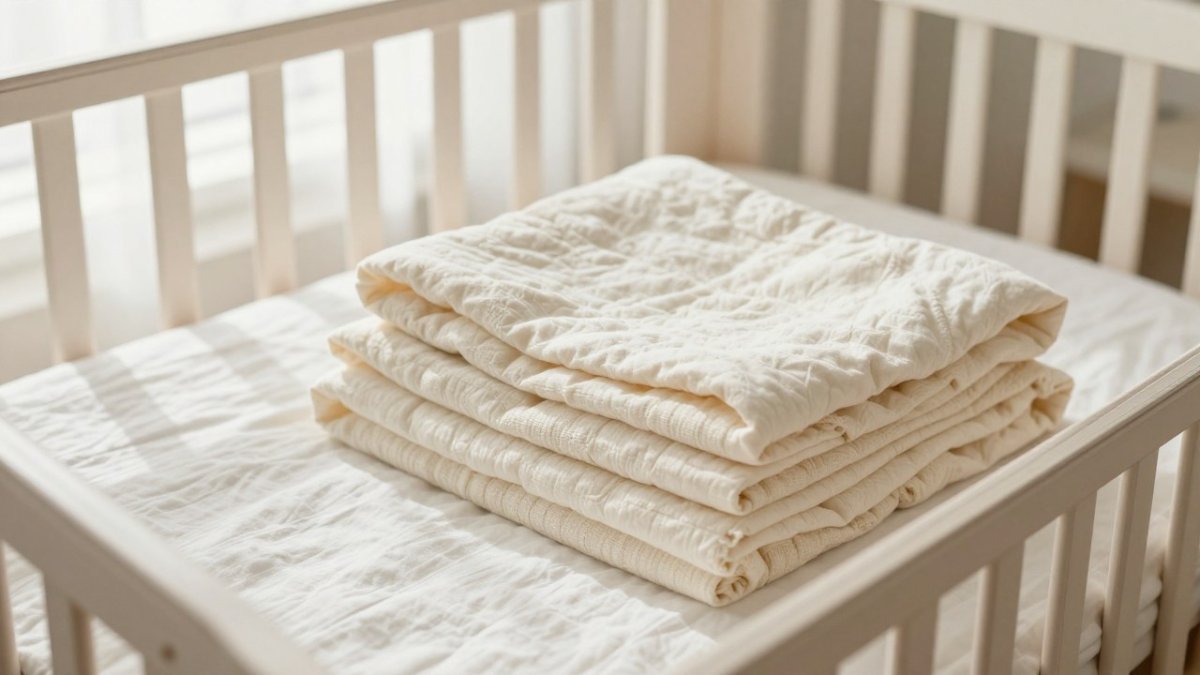
For the sleep surface, the mattress matters as much as the sheets. Look for a mattress with a disclosed core (organic cotton, wool or a certified foam) and a removable, washable cover, and confirm the mattress meets the federal flammability standard without added chemical flame retardants where the maker states that.
Wall art can be low-impact with a few checks. Framed prints on paper or canvas avoid the adhesive and vinyl of many decals, which can off-gas and are hard to remove without damaging paint. If you use decals, choose removable fabric or paper versions and test one in a corner first. For frames, solid wood or metal beats particleboard, and water-based finishes beat solvent lacquers.
A practical textile and decor checklist:
Baby Bumper Bed Braid Knot Pillow Cushion Bumper for Infant cuna Bebe lit Crib →
- Bedding and blankets: GOTS or OEKO-TEX Standard 100 labeled, pre-washed before use
- Mattress: disclosed core, snug fit, no unlisted flame-retardant treatment
- Curtains: natural fiber or documented low-emission fabric, cordless or secured cords
- Rugs: washable, low-pile, with a non-slip pad; avoid strong "new carpet" odor
- Wall art: framed paper or canvas, water-based finish, mounted out of reach
- Soft decor: removable, washable, and free of loose buttons or small parts
Watch out: "organic" on a package can refer to only one component, such as the cover but not the fill, so read the fine print for which parts are certified.
Room-by-Room Buying Checklist and Budget Tiers
Planning a nursery is easier with a clear list. Work through the room in this order and buy the essentials first.
- Crib or bed with a low-VOC finish and a sturdy, certified frame
- Dresser or storage with solid wood construction
- Low-VOC paint for walls, plus a primer and sealer for wood
- Organic or natural-fiber crib bedding
- Bumper or crib protector suited to your crib
- Washable blankets and swaddles
- Wall art, rugs and soft decor added last
For budget, think in three tiers. A budget setup prioritizes the crib, mattress and paint, then adds washable textiles over time. A mid-range setup adds solid wood storage and a few natural-fiber pieces. A higher-budget setup adds sustainable furniture designed to convert and last. Spending more on the items that touch the baby most, such as bedding and the sleep surface, is often a better use of money than premium decor.
How to Verify Sustainability and Safety Claims
Many shoppers are told to "look for certifications" without being told which ones matter or what they cover. This section walks through the specific labels, disclosures and questions that separate substantiated claims from vague green marketing.
Start with the certification, not the adjective. A credible claim names a standard and a certifying body. Common ones you will see on nursery products:
- GOTS (Global Organic Textile Standard): covers organic fiber content, dye restrictions and processing for textiles. Look for the license number on the label.
- OEKO-TEX Standard 100: tests the finished article for harmful substances. It does not certify that the fiber is organic, so it complements rather than replaces GOTS.
- GREENGUARD Gold: tests furniture, mattresses and finishes for low chemical emissions, with stricter limits than the base GREENGUARD certification. Useful for cribs, dressers and mattresses.
- FSC (Forest Stewardship Council): certifies wood and paper from responsibly managed forests. Look for the FSC label and chain-of-custody code on solid wood furniture.
- Cradle to Cradle Certified: scores products across material health, recyclability and social fairness. Less common in nursery decor but appears on some furniture and finishes.
- UL GREENGUARD and UL Environment marks: third-party tested emissions claims, often paired with low-VOC paint and sealers.
A label only helps if you check its scope. Ask whether the certification covers the whole item or one component, such as the fabric but not the dye, or the frame but not the finish. Ask for the certificate number and the standard version, and confirm the certifying body is independent of the seller.
For paint and finishes, ask for emissions data, not just the VOC number. Low-VOC and zero-VOC labels refer to volatile organic compounds, but a paint can be low-VOC and still contain other solvents or biocides. Ask whether the product is GREENGUARD Gold certified and whether the tinting system adds VOCs after the base is tested. For wood finishes, ask for water-based vs. solvent-based and whether the sealer is included in the emissions claim.
For furniture, ask three questions: What is the core material (solid wood, plywood, particleboard, MDF)? What is the finish (water-based, oil, lacquer)? And is there a California Air Resources Board (CARB) Phase 2 or TSCA Title VI compliance statement for composite wood? Those rules limit formaldehyde emissions from composite wood products sold in the U.S., and a compliant seller should be able to point to the statement (the EPA).
For mattresses and bedding, ask about flame retardants. Federal flammability rules require mattresses to resist ignition, but some makers meet the standard with barrier materials or wool rather than chemical treatments. Ask whether the maker states "no added chemical flame retardants" and how the mattress meets the standard. For bedding, confirm the finished-article test (OEKO-TEX Standard 100) and whether dyes are fiber-reactive.
A short verification checklist you can run before buying:
- Does the claim name a standard and a certifying body?
- Is there a certificate or license number I can look up?
- Does the certification cover the whole item or one component?
- For wood: is there a CARB Phase 2 or TSCA Title VI statement?
- For paint: is there emissions data beyond the VOC number?
- For mattresses: is the flame-retardant approach disclosed?
- Does the seller answer these questions in writing?
Watch out: a logo without a certificate number, or a claim that covers only the packaging or one component, is the most common sign of vague green marketing.
Planning Your Nursery Refresh This Season
Plan your nursery refresh in stages rather than all at once. Start with paint and ventilation, since the room needs time to air out. Then add the crib and storage, and finish with textiles and decor. Washing new fabrics before use and checking that each piece is stable and securely assembled will keep the room both eco-friendly and safe. A well-planned nursery is one you can keep, reuse and enjoy for years.
Frequently Asked Questions
What makes a nursery eco-friendly?
An eco-friendly nursery focuses on materials that are durable, low in chemical emissions, and easy to reuse or pass down. Prioritize solid wood furniture, natural-fiber textiles such as cotton and linen, and low-VOC paint. Choosing pieces that can be reused for a second child or resold later also reduces waste. Start with the items your baby uses most, like the crib and bedding, since they spend the most time in the room.
How can I decorate a nursery without toxic chemicals?
Look for paints labeled low-VOC or zero-VOC, and let the room ventilate for several days after painting before the baby moves in. Choose untreated wood or wood finished with water-based products, and wash new textiles before use. Wall art made from paper, cotton, or wood is a simple way to add color without introducing chemical-heavy materials. Opening windows during and after decorating improves indoor air quality.
Are organic materials necessary for baby nursery decor?
Organic materials are not strictly necessary, but they reduce exposure to pesticides and synthetic treatments often used in conventional cotton. For items that touch the baby's skin, such as crib sheets and blankets, organic cotton is a reasonable priority. For decorative items that stay out of reach, such as wall art or shelves, durable untreated wood or recycled materials can be just as sensible and often cost less.
Where can I find sustainable nursery decor?
Browse online shops that specify materials and finishes in their product listings, and check whether the product details name the fabric, wood type, and dyes used. Modocam Kids offers baby bedding and room accessories such as the Polar Dot Baby Blanket at $17.03 and the Foldable Baby Bed Net With Pillow Net 2-piece set at $19.26, which you can compare against the material details on each listing. Secondhand furniture and resale platforms are also good sources for solid wood pieces.


