

Cart
0
Last Updated: November 1, 2026
Quick Summary
Adjustable handlebars improve stroller safety by letting each caregiver set the bar to a height that keeps wrists straight and elbows slightly bent, so you grip firmly and steer with small, controlled movements. A properly locked handlebar also reduces fatigue and strain on your back, shoulders, and wrists.
- Set the bar near your natural waist with forearms roughly parallel to the ground.
- Aim for a soft elbow bend of roughly 10 to 20 degrees, not locked elbows.
- After adjusting, push down hard on the bar to confirm it does not slide or click.
- Mark your preferred setting with tape or a sticker to speed up caregiver handoffs.
- A handlebar that slips mid-walk can tip the stroller or wrench your wrist.
Table of Contents
- How Adjustable Handlebars Improve Stroller Safety
- Finding the Right Adjustable Stroller Handlebar Height
- How Handlebar Height Affects Back, Shoulder, and Wrist Strain
- Inside the Stroller Handlebar Locking Mechanism
- Sharing One Stroller Between Caregivers of Different Heights
- Control, Stability, and Balance in Everyday Situations
- A Stroller Safety Checklist for Every Walk
- Choosing a Stroller With Handlebars That Fit Your Family
- Frequently Asked Questions
How Adjustable Handlebars Improve Stroller Safety
The benefits of adjustable handlebars for stroller safety start with one fact: you steer a stroller with your hands, so the handle has to fit them.
Parents often blame their stroller for feeling twitchy or heavy. Often the fix is not a new stroller, it is a handlebar adjustment.
Adjustable handlebars are stroller handles that slide or click into more than one height position.
Here is the short answer on why that matters:
- Better grip. Your hands stay wrapped around the bar, not slipping off the top.
- More use. You push from your legs and core, not your shoulders.
- Steadier steering. A relaxed arm corrects direction with small movements.
- Less fatigue. You stay alert longer on long walks.
The Consumer Product Safety Commission guidance on stroller safety treats secure, intact hardware as a core part of stroller safety. For a deeper look at the premium baby stroller safety features that matter most, see our full guide.
Better Control Starts at the Handle
Control comes from small corrections. A handle at the wrong height makes every correction bigger than it needs to be.
When the bar sits too low, your wrists bend back and you push with your palms instead of your fingers.
When the bar sits too high, your elbows lock, passing every bump straight into your shoulders.
A properly set handlebar keeps your arms slightly bent. That bend acts like a shock absorber.
Finding the Right Adjustable Stroller Handlebar Height
The right adjustable stroller handlebar height puts the bar near your natural waist, with your forearms roughly parallel to the ground.
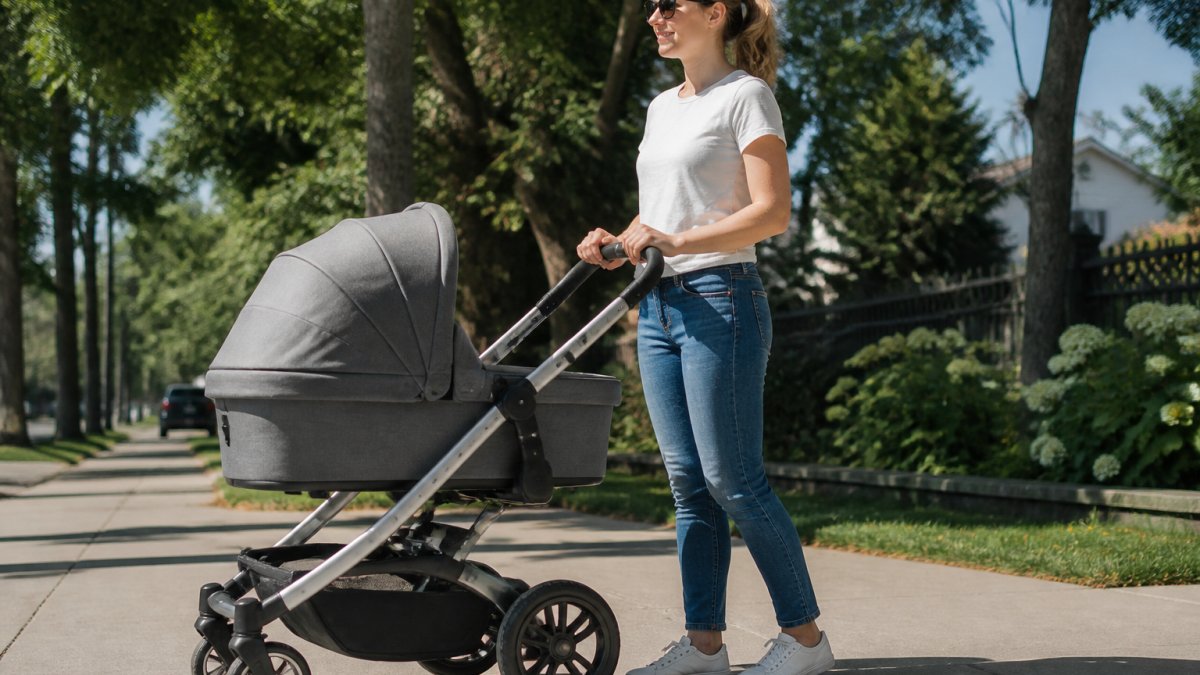
Most stroller manuals specify a handlebar height range rather than a single setting, because the right height depends on the person pushing. Check your manual for the stated range before you adjust.
Step-by-Step: Set and Confirm the Height
Follow these steps to set it:
- Park on level ground and engage the brake. Setting height while the stroller can roll makes it hard to judge your posture.
- Stand behind the stroller with both feet flat and shoulders relaxed. Wear the shoes you normally walk in; heel height changes your reach.
- Loosen the adjustment button or collar on each side. If your stroller has a single central release, confirm both sides move together.
- Slide the handle to roughly hip or waist height. A good starting point is the crease of your wrist when your arms hang at your sides.
- Grip the bar and check your elbow angle. You want a soft bend of roughly 10 to 20 degrees, not locked elbows and not a sharp angle that pulls your shoulders forward.
- Check wrist position. The back of your hand should be roughly in line with your forearm. If your wrist bends up or down to reach the bar, the height is off.
- Lock both sides and pull up firmly to test the hold. Push down on the bar as well, since a joint can hold under tension but slip under compression.
- Take ten steps. If you feel tension in your neck, shoulders, or lower back, move the handle one notch and repeat.
Pro Tip
Mark your preferred setting with a small piece of tape or a sticker on the tube. It makes resetting after a handoff or a fold much faster.
A Quick Fit Check for Any Caregiver
Use this checklist before every handoff between parents, grandparents, or a sitter:
- Wrists are straight, not bent up or down
- Elbows have a slight bend of roughly 10 to 20 degrees
- Shoulders are down, not shrugged
If any box stays unchecked, move the handle one notch and repeat. Two or three adjustments usually get most caregivers close; fine-tuning after a short walk catches the rest.
Fit Checks by Caregiver Height
The same stroller can fit a tall parent and a shorter grandparent, but the settings will be far apart. A few practical markers help:
- Taller caregivers often need the bar near the top of its range so their elbows do not lock. If the bar maxes out below waist height, they will lean forward and load their lower back.
- Shorter caregivers often need the bar lower so their shoulders stay relaxed. A bar set too high forces the elbows up and the shoulders toward the ears.
- Caregivers with limited grip or wrist strength should favor a height that keeps the wrist neutral, since a bent wrist reduces grip force and makes the stroller harder to control.
Confirm the Lock Before You Walk
A height that looks right but is not locked is a safety problem, not a comfort one. After adjusting, do three checks:
- Push down hard on the bar and watch for any slide or click.
- Twist the bar side to side to check for play in the joint.
- Lift the front wheels slightly using the handle, the way you would to mount a curb, and confirm the handle holds.
If the bar slips during any of these checks, do not walk with the stroller until the joint is repaired. A handlebar that gives way mid-walk can tip the stroller or wrench your wrist.
How Handlebar Height Affects Back, Shoulder, and Wrist Strain
A handlebar that is too low is the most common cause of back strain in stroller pushing.
Too high a bar shifts the problem upward: your shoulders creep toward your ears, and tension builds across your upper back.
Wrist strain comes from angle, not height alone. A bar that tilts your hands backward puts pressure on the wrist joint with every step.
The fix is the same in all three cases: match the bar to the person pushing, not the stroller's default setting. Parents who share a stroller should reset the height each time they swap.
Inside the Stroller Handlebar Locking Mechanism
A stroller handlebar locking mechanism is the clamp, pin, or collar that holds the handle at a chosen height. Most strollers use one of three designs:
Two Way Stroller Lightweight Foldable Stroller →
| Lock Type | How It Works | What to Check |
|---|---|---|
| Push-button pin | Spring pin clicks into holes | Pin fully seated in a hole |
| Twist collar | Collar tightens around the tube | Collar snug, no spinning |
| Lever clamp | Lever flips to lock the joint | Lever flush, firm resistance |
Whatever the design, the test is the same. Lock it, then push down hard on the bar. It should not slide, twist, or click.
Watch out: a handlebar that slips mid-walk can tip the stroller or wrench your wrist. Stop using the stroller until the joint holds.
Signs an Adjustment Joint Needs Attention
Check the joint every few weeks, and after any trip where the stroller was checked or folded roughly. Look for:
- Wobble or side-to-side play in the handle
- A pin that no longer clicks into place
- Cracks or whitening in the plastic collar
Loose hardware is fixable. For stroller wheel repair or replacement guidance, see our maintenance article. If a joint is cracked, stop using that stroller until it is repaired or replaced.
Sharing One Stroller Between Caregivers of Different Heights
Shared strollers rarely fit everyone. A tall parent and a shorter grandparent need very different bar heights.
The practical fix is a quick reset routine:
- Note your own setting, or mark it with a small sticker.
- Reset the bar before each handoff.
- Keep the adjustment button clean so it moves freely.
- Teach every caregiver the lock test.
One stroller can serve the whole family this way. It just needs a two-minute reset, not a second purchase.
Control, Stability, and Balance in Everyday Situations
Handlebar height changes how the stroller behaves on real ground. The common thread is leverage: the handlebar is where your body force meets the frame, so a bar that fits you lets you apply force in the direction you intend.
Curbs and Steps
To mount a curb, you push down on the handlebar to lift the front wheels, then roll forward. A bar at the right height lets you do this with a light push and straight wrists. Too low, and you lean over the stroller, putting your weight ahead of the rear wheels so it feels like it wants to tip forward.
Slopes
On a downhill, you hold the stroller back. A well-fitted bar lets you do that with your legs and core, keeping your arms relaxed. A bar that is too low pulls your shoulders forward and makes it harder to resist the forward roll. On an uphill, a bar that is too high forces you to push with locked elbows, passing every bump into your shoulders and reducing your ability to steer.
Tight Turns and Crowded Sidewalks
Small steering corrections come from your fingertips and wrists. When the bar fits, your wrists stay neutral and you make those corrections without thinking. When the bar is too low, your wrists bend back and you push with your palms, making every correction larger than it needs to be. In a crowd, that shows up as oversteering and near-misses.
Uneven Paths and Sidewalk Cracks
A slight elbow bend acts as a shock absorber. With soft elbows, a bump moves your arms a little and the stroller stays on course. With locked elbows, the same bump travels into your shoulders and can jolt your grip loose. That is one reason a properly fitted bar feels steadier on brick sidewalks and gravel paths.
Stopped and Resting
Balance matters most when you are stopped. A parent who leans on the bar to rest puts weight in the wrong place and shifts the stroller's center of gravity. A parent standing upright keeps the stroller balanced over its rear wheels, where it is most stable when a child shifts around.
Watch Out
An adjustable handlebar improves your control, but it does not replace the harness, the brake, or supervision. A child who leans over the front grab bar can shift weight onto the front wheels no matter how well the handlebar fits. Buckle the harness snugly and keep a hand on the stroller whenever a child is seated.
A Stroller Safety Checklist for Every Walk
Run this stroller safety checklist before you head out:
- Handlebar locked at the right height for the person pushing
- Both sides of the handle at the same setting
- Brake tested on a slight slope
That last point matters. A child who leans forward shifts weight onto the front wheels. A parent with good handlebar use can correct for it. A parent hunched over the bar cannot.
Choosing a Stroller With Handlebars That Fit Your Family
Buy a stroller with a handlebar range that covers your tallest and shortest caregiver. If you want guidance on choosing a stroller for long term use, our guide walks through what to look for.
Look for a retractable or sliding push handle, a lock that engages on both sides, and a bar you can grip without stretching. You can also evaluate a concrete stroller product against these fit criteria.

If you want a concrete option to compare against these criteria, the Two Way Stroller Lightweight Foldable Stroller has a retractable push handle and a high carbon steel reinforced body, priced at $48.80.
Frequently Asked Questions
How do adjustable handlebars improve stroller safety?
Adjustable handlebars let you set the handle at a height where your arms stay slightly bent and your wrists sit neutral. That posture gives you firmer control when steering, braking, or stopping on a slope, and it reduces the muscle tension that builds over a long walk. A handle that sits too high or too low pushes you to lean or hunch, which makes the stroller harder to correct quickly. The adjustment itself does not add safety features, but it helps you use the stroller the way it was designed to be pushed.
What is the correct handlebar height for pushing a stroller?
Set the handlebar so your forearms rest roughly parallel to the ground and your elbows keep a slight bend. Your wrists should stay in a neutral position rather than flexed up or down. Stand close enough that you are not reaching forward, and check that your stride does not kick the rear axle. If you feel pressure in your lower back or shoulders within a few minutes, the handle is probably too low or too high. Adjust, lock, and walk a short distance to confirm the fit before heading out.
Can the wrong stroller handlebar height cause back or shoulder strain?
Yes. A handlebar set too low forces you to hunch forward, which loads the lower back and shoulders. Set too high, it lifts your shoulders and locks your elbows, which builds tension through the upper back and arms. Both positions also push your wrists out of a neutral angle. Parents who log long daily walks notice this fastest. Adjusting the height so your arms stay slightly bent and your shoulders stay relaxed is the simplest fix, and it takes less than a minute on a stroller with a working adjustment joint.
How can I check that an adjustable stroller handlebar is locked securely?
After setting the height, press the adjustment button or release the lever and confirm it clicks back into place. Then push down firmly on the handlebar with both hands and try to slide it up or down. It should not move. Give the stroller a short push on flat ground and check again. If the handlebar shifts, wobbles, or the button feels loose, stop using that setting until you inspect the joint. A handlebar that will not stay locked is a repair issue, not something to work around.
Pushing a stroller should not leave your back sore or your wrists aching. If your current handlebar will not lock firmly or will not fit the adults in your household, it is time to upgrade. Modocam Kids carries strollers built around comfort and care, with retractable push handles, reversible seats, and foldable frames for daily use. Get started with Modocam Kids and find a stroller that fits every caregiver in your family.


