

Cart
0

Table of Contents
- Start With Your Hike, Then Pick the Baby Carrier for Hiking
- Hiking Baby Carrier Age and Weight Limits: What Your Child Is Ready For
- Soft Structured Carrier vs Framed Hiking Carrier: Which Belongs on Your Trail
- How to Fit a Hiking Baby Carrier to Your Body and Your Child's
- Ventilation, Heat, and Weather on the Trail
- What to Pack for Hiking With a Baby
- Trail Safety, Visibility, and Emergency Planning
- Conclusion
- Frequently Asked Questions
Last Updated: October 15, 2026
Start With Your Hike, Then Pick the Baby Carrier for Hiking
Most parents shop for a carrier first and plan the trail second, backwards, and why so many get resold after two outings. A baby carrier for hiking is trail equipment, not a stroller substitute; the right one depends on where you're walking, how long you'll be out, and who's carrying whom.

Below, we'll break down how to match the carrier to the hike, then to your child's development, then to your own body. The American Academy of Pediatrics guidance on infant carriers is a good starting point for safety basics, but fit and trail choice are where most guides stay vague.
Key Takeaway
Pick the hike category first (short and flat, half-day, or full-day mountain), then choose a carrier type that matches it. The carrier should follow the trail, not the other way around.
Hiking Baby Carrier Age and Weight Limits: What Your Child Is Ready For
Age and weight limits matter, but head and torso control matter more. The real readiness signal is whether your baby can hold their head steady without support.
Read each carrier's own limits first. The Breathable Double-shoulder Baby Carrier supports up to 15kg, while the Double Shoulder Baby Carriers model is rated for babies 0-24 months with a maximum load of 16kg, structural limits, not developmental ones.

Head and Torso Control Comes Before Any Weight Number
A baby who can't hold their head up steadily shouldn't ride in a hiking carrier on uneven ground, rocky-trail jostling is nothing like a sidewalk.
Wait for steady head control before a real trail. For newborns, a wrap-style or front-carry option with firm head support is safer; save structured trail carriers for when your baby can sit supported without bobbing.
Soft Structured Carrier vs Framed Hiking Carrier: Which Belongs on Your Trail
The choice comes down to hike length and terrain, not brand loyalty: soft-structured carriers win on short, gentle walks; framed backpack carriers on long, uneven trails needing load transfer and storage.
Here's how the two compare in practice:
| Factor | Soft-Structured Carrier | Framed Backpack Carrier |
|---|---|---|
| Best for | Walks under 2 hours, flat paths | Half-day to full-day, uneven trails |
| Weight distribution | Shoulders and hips | Rigid frame shifts load to hips |
| Storage | Minimal to moderate | Built-in pockets and compartments |
| Bulk when folded | Packs small | Takes up trunk space |
| Child view | Close to your body | Elevated, wider view |
| Child age sweet spot | Newborn through toddler | Sitting independently through preschool |
| Caregiver torso fit | Adjusts to most body types | Fixed frame length; less forgiving |
| Resale and reuse | Holds value across multiple children | Bulkier to store between kids |
A buckle carrier close to your chest keeps your center of gravity stable on flat ground. A framed carrier raises the child higher, which many toddlers prefer, and puts weight on your hips rather than your shoulders.
A Decision Guide by Hike Type
Use this to pick before you shop:
- Paved loop or boardwalk, under 90 minutes, child under 6 months: soft-structured carrier with firm head support. The frame's bulk is dead weight on flat ground.
- Flat or rolling trail, 2 to 3 hours, child sitting independently: soft-structured carrier with a padded hip belt. You get load transfer without the frame.
- Uneven trail with roots and rock, half-day, child 9 months and up: framed backpack carrier. The frame keeps the child's weight off your shoulders on descents and lets you use trekking poles safely.
- Full-day mountain hike with elevation gain: framed carrier with a hydration sleeve and hip belt that transfers most of the load. Plan on 15 to 20 pounds of combined child and gear weight.
- Mixed-use family: one soft carrier plus one framed carrier covers nearly every hike you'll take in the first three years.
Match the Carrier to the Caregiver, Not Just the Child
Torso length matters as much as child weight. A framed carrier's fixed frame height means a short-torsoed caregiver may find the hip belt rides too low, while a tall one may find the shoulder straps too short. Soft-structured carriers with adjustable torso panels fit more body types.
Pro Tip
If your trail has roots, loose rock, or a steady climb, the frame earns its bulk. If you're doing a paved loop or a boardwalk, the soft carrier is lighter and easier to manage.
For a middle ground, the Ergonomic Baby Carrier offers three modes (single carrier, hip seat, or combined) and fits a waist range of 71cm to 110cm, so one carrier can adapt as your child grows and your hikes change.
How to Fit a Hiking Baby Carrier to Your Body and Your Child's
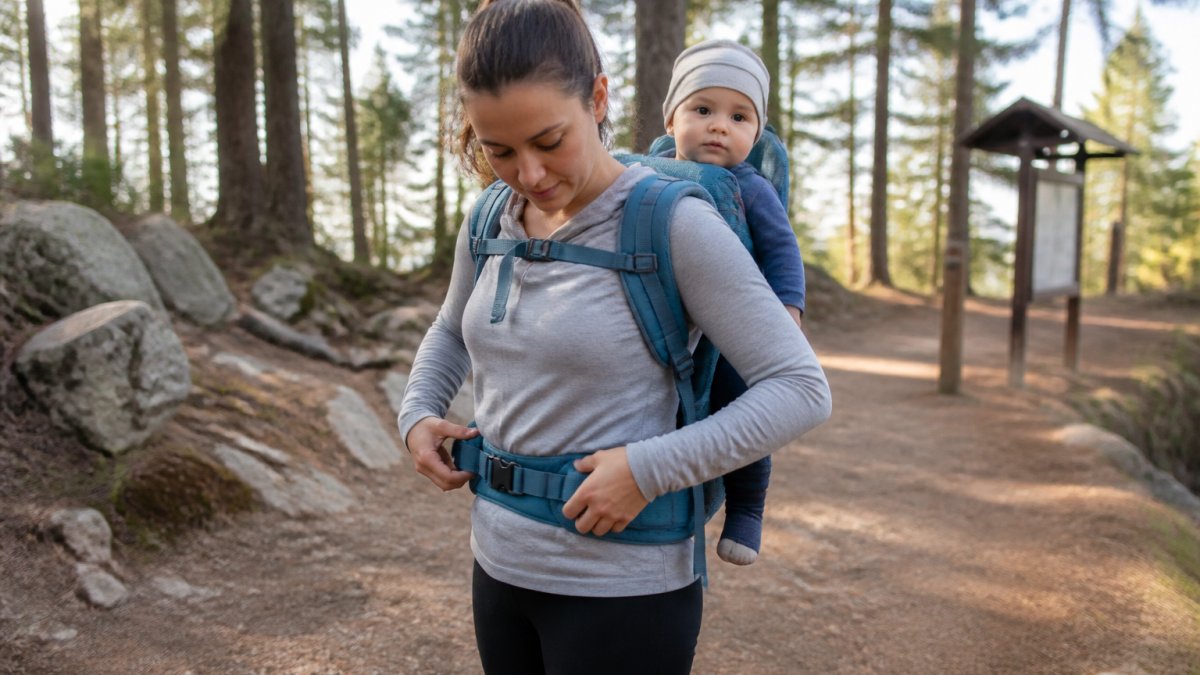
A correctly fitted carrier should feel like part of your torso, not hanging off your shoulders. Most discomfort comes from a loose hip belt and straps that are too long, not the carrier itself.
The Adjustment Sequence That Actually Works
Tighten in this order, and don't skip steps:
- Waist belt first. Buckle and tighten until it sits on your hip bones, not your stomach, snug enough that you can't slide a hand under it, but not so tight it digs in when you breathe deeply. This belt carries most of the load.
- Shoulder straps second. Tighten evenly until the carrier hugs your back without pulling your shoulders forward and there's no gap at the collarbone.
- Chest strap third. Slide it to a comfortable height across your sternum, usually a few inches below your collarbone, and tighten just enough to keep the shoulder straps from sliding outward.
- Child seat last. With the child in, adjust seat depth and panel height so their knees sit at or above hip level and their back is supported in a natural curve, not slumped.
If the carrier sags or the child sits too low after all four steps, the waist belt is the culprit: loosen the shoulder straps, retighten the belt, then re-tighten the shoulders.
A Fit-Testing Checklist for Caregiver and Child
Run through this before you leave the trailhead:
- Waist belt sits on your hip bones, not your stomach, and feels snug
- Shoulder straps are tightened evenly, no gap at the collarbone
- Child's knees sit at or above hip level, not dangling straight down
- Child's back is supported in a natural curve, not slumped
- Head and neck are supported if your child is still developing control
- You can slide two fingers under each strap, no more
If any box is unchecked, readjust before you walk. A carrier that fits at the car will still fit at mile three; one that's slightly off will be painful by then.
Test It on a Short Walk Before You Commit
Don't judge a fit standing still. Walk 10 to 15 minutes on a sidewalk or flat path before a real trail, watching three things:
- Pressure points: Any spot that feels like a bruise forming will be worse at mile two. Adjust the belt or straps and try again.
- Child position: Check that your child hasn't slumped or shifted. If they have, the seat depth or panel height needs adjustment.
- Breathing: You should be able to take a full breath without the chest strap restricting you. If not, lower the chest strap or loosen it slightly.
If the fit holds after 15 minutes, it will likely hold for a two-hour hike. If not, fix it before you leave the neighborhood.
Breathable Double-shoulder Baby Carrier Four Seasons Multifunctional Baby →
Shared Use and Body Differences
If two caregivers share the carrier, reset the waist belt, shoulder straps, and chest strap each swap.
A practical trick: mark your settings with tape or a permanent marker line on the webbing, so you can return to your fit in seconds instead of guessing.
Soft-structured carriers with adjustable torso panels fit more body types than framed carriers' fixed frame height.
Ventilation, Heat, and Weather on the Trail
Overheating is the most common trail problem with babies, and easy to miss because a child in a carrier can't move away from your body heat, your core temperatures combine inside the carrier.
Mesh panels and breathable fabrics make a real difference on warm days. The Breathable Double-shoulder Baby Carrier is built around airflow, and the Multifunctional Carrier Sling uses a polyester-cotton blend that breathes better than dense padding.

Dress your baby in one layer lighter than you'd wear standing still. Check the back of their neck, not their hands, to judge temperature.
Watch Out
Never cover your baby's face with a blanket or carrier flap to block sun or wind. It traps exhaled air and raises the risk of overheating. Use a hat and shade instead.
What to Pack for Hiking With a Baby
Pack for the hike you're actually doing, then add baby essentials. Extra weight compounds with every mile, so keep the load lean.
Carry these in the carrier's storage or a small daypack:
- Diapers and wipes, one per expected hour plus two spare
- A full water bottle for you, and a bottle or sippy cup for your child
- Snacks that don't melt or crumble easily
- A light blanket or muslin for shade and ground cover
- Sunscreen and a wide-brimmed hat
- A spare onesie in a sealed bag
The Ergonomic Baby Carrier includes a large-capacity storage section, cutting down on what you carry separately. If your carrier has minimal storage, a compact daypack beats overloading its pockets.
Trail Safety, Visibility, and Emergency Planning
Trail safety with a baby comes down to three things: being seen, staying reachable, and knowing when to turn around. Plan all three before you park.
Wear bright colors, and add a reflective element if you'll be out near dusk or on a road-adjacent path.
Set a turnaround time, not just a destination. If your baby is fussy, the weather shifts, or you're more tired than expected, that time is your signal to head back.
Key Takeaway
The best safety tool on a hike with a baby is an early turnaround. Decide the time before you start, and honor it even when the summit looks close.
Conclusion
Choosing a comfortable baby carrier for hiking gets easier once you stop shopping by looks and start shopping by trail.
At Modocam Kids, we stock carriers built for real trail use, from the breathable double-shoulder design to the three-in-one ergonomic model with hip seat support and generous storage, each chosen for comfort, care, and style.
Add to Cart and get your family trail-ready with gear designed to grow alongside your child.
Frequently Asked Questions
What age can you use a hiking carrier?
Most framed hiking carriers are rated for children around 16 pounds and up, which typically means 6 months or older, and they stay usable until roughly 40 pounds. Soft-structured carriers can work from the newborn stage with an infant insert, but trail use usually waits until your baby has steady head and neck control. Always check the specific weight limit on the carrier you buy, since ratings vary by model.
How should a hiking baby carrier fit the adult?
The hip belt should sit on your hip bones, not your waist, and carry most of the load. Padded shoulder straps should rest flat without digging into your neck, and the sternum strap should sit across your chest at a comfortable height. Tighten everything before you start walking, then recheck after ten minutes. A carrier that fits well keeps the child's weight close to your center of gravity, which reduces strain on your back and shoulders over a long hike.
How do you choose between a soft carrier and a framed hiking carrier?
Match the carrier to the hike. Soft-structured carriers pack small, weigh little, and suit short, flat walks or errands. Framed backpack carriers add structure, a kickstand, and real storage capacity, which makes them better for longer trails, uneven terrain, and carrying supplies for a full day. If you hike often and your child is past the newborn stage, a framed carrier usually earns its bulk.
What should a baby wear in a carrier on a hike?
Dress your baby in one layer more than you would wear for the same conditions, then check their neck and chest for overheating every 20 to 30 minutes. Avoid bulky snowsuits, which stop the carrier from fitting snugly. A hat, light long sleeves, and moisture-wicking fabric work well in most conditions. In cold weather, add a carrier cover or blanket over the carrier rather than layering the baby up inside it.

