

Cart
0

Table of Contents
- Signs Baby Is Ready for Solids: A Readiness Checklist
- Safe First Foods for Baby: What to Offer First
- How to Prepare Baby Food to Prevent Choking
- Introducing Allergens to Babies: A Step-by-Step Plan
- How Much and How Often: Portions and Feeding Frequency
- Feeding Gear That Makes Starting Solids Safer and Easier
- Conclusion: Your First Week of Solids
- Frequently Asked Questions
Last Updated: October 14, 2026
Signs Baby Is Ready for Solids: A Readiness Checklist
Starting solids is a big step, and timing matters. The American Academy of Pediatrics recommends waiting until around 6 months before introducing solid foods, alongside breast milk or formula.
Readiness is a set of skills, not a birthday. A baby who sits well and reaches for your plate is ready. A baby who slumps or pushes food out with the tongue is not, even at 6 months.
Developmental Signs to Look For
Watch for these signs together, not one at a time:
- Steady head control with no bobbing
- Sitting upright with little or no support
- Showing interest in food and watching you eat
What to Skip and When to Wait
Skip solids before 4 months, a baby's swallow is not ready, and early feeding raises choking risk. Wait if your baby was born premature; adjusted age matters more than birth age. Ask your pediatrician first if your baby has feeding or developmental needs.
Watch Out
Do not prop a baby up in a high chair or bouncer to feed solids. A slumped or reclined position raises the risk of choking. A baby should sit upright, strapped in, with feet supported.
Safe First Foods for Baby: What to Offer First
The best first foods are soft, single-ingredient, and easy to swallow: pureed or mashed vegetables, fruit, and iron-rich options like infant cereal or well-cooked meat puree. Offer one new food at a time, wait a few days, then add the next.
Best First Foods to Try
- Pureed or mashed sweet potato, squash, or carrot
- Mashed banana or avocado
- Iron-fortified infant cereal mixed with breast milk or formula
Foods to Avoid in the First Year
- Honey, which can cause infant botulism (the CDC)
- Unpasteurized dairy and unpasteurized juice
- Raw or undercooked meat, seafood, and eggs
How to Prepare Baby Food to Prevent Choking
Texture is where safety is won or lost. A food that is safe mashed can be dangerous in chunks. The rule: if you can squish it between your thumb and forefinger, it is soft enough.
Safe Textures and Consistency by Age
| Age | Texture | Example |
|---|---|---|
| 6-8 months | Smooth puree, thin | Strained carrot |
| 8-10 months | Mashed, thick | Fork-mashed banana |
| 10-12 months | Soft lumps, finely chopped | Cooked pasta pieces |
| 12+ months | Soft table food, bite-sized | Diced soft chicken |
Choking Hazards and How to Modify Them
- Whole grapes → quarter them lengthwise
- Carrot sticks → cook until soft, or grate raw
- Hot dogs → cut lengthwise into thin strips
Pro Tip
Test every new food with the "squish test" before it goes on the tray. If it does not flatten easily between your fingers, cook it longer or cut it smaller. This one habit prevents most choking incidents at home.
Gagging vs. Choking: Know the Difference
This is the part that matters most at 7 p.m. on a Tuesday.
Gagging is normal and protective, a loud, forward, forceful reflex that pushes food out of the airway. You will see:
- Coughing, sputtering, or a wet gurgle
- Tongue thrusting forward
- Red face, watery eyes, open mouth
Do not sweep a finger into the mouth during a gag, that can push food further back. Stay calm, keep baby upright, and let the reflex finish.
Choking is silent and needs action. The airway is blocked. You will see:
- No sound, or a weak, high-pitched squeak
- Inability to cry, cough, or breathe
- Skin turning blue or gray, especially around the lips
What to Do If Your Baby Chokes
If your baby is coughing forcefully, let them cough, the airway is clearing itself. If the cough is silent or ineffective, act immediately:
- Call 911 or have someone else call while you begin.
- For a baby under 1 year: give 5 back blows between the shoulder blades with the heel of your hand, with the baby face-down along your forearm and head lower than the chest. Then give 5 chest thrusts with two fingers on the center of the chest. Alternate 5 and 5 until the object clears or help arrives.
- Do not perform abdominal thrusts (the Heimlich maneuver) on a baby under 1 year. It can cause serious internal injury.
- If the baby becomes unresponsive, begin infant CPR and continue until EMS takes over.
Watch Out
Take a hands-on infant CPR and choking course before your baby's first bite. The American Red Cross and many hospitals offer short in-person and blended courses. Reading about back blows is not the same as practicing them on a manikin.
Prevention Mechanics Beyond Texture
- Seat baby fully upright at roughly 90 degrees, strapped into a high chair with feet supported. Reclined or slouched positions raise risk.
- Never feed in a moving car, stroller, or while baby is crawling or walking.
- Stay within arm's reach for the entire meal. Choking is silent, so you cannot rely on hearing it from the next room.
Feeding therapists note that most choking incidents at home trace back to three things: a hazard food in the wrong shape, a baby eating while reclined or moving, or an adult who stepped away. Fix those three and you have removed most of the risk.
Introducing Allergens to Babies: A Step-by-Step Plan
Introducing allergens early and often is now the standard approach, not something to delay. Current guidance from the American Academy of Pediatrics on infant food allergies supports offering common allergens starting around 6 months, alongside other foods, and continuing them regularly once tolerated.
The nine allergens to introduce in the first year are: peanut, egg, cow's milk (as an ingredient, not as a drink), soy, wheat, tree nuts, fish, shellfish, and sesame. Sesame is the newest addition to the major-allergen list and is easy to overlook.
The Order and the Schedule
There is no required order. What matters is that each allergen gets introduced, tolerated, and kept in rotation. A workable pattern:
- Pick one allergen and offer it in the morning or early afternoon, not at bedtime. You want wakeful hours to watch for a reaction.
- Start small. A common starting dose is about 1/4 to 1/2 teaspoon of the allergen mixed into a food your baby already tolerates well.
- Wait 10-15 minutes and watch closely. Most IgE-mediated reactions show up within minutes to two hours.
- If all is well, offer the rest of the small serving and finish the meal.
- Keep offering that allergen 2-3 times per week to maintain tolerance. Skipping weeks can undo the benefit.
- Wait 3-5 days before starting the next new allergen, so a reaction can be traced to a single food.
How to Serve Each Allergen Safely
| Allergen | Safe first serving |
|---|---|
| Peanut | 1/4 tsp smooth peanut butter thinned with water or puree, or peanut powder stirred into cereal. Never whole nuts or a straight spoonful of nut butter. |
| Egg | Well-cooked scrambled egg or hard-boiled yolk mashed into puree. No raw or runny egg. |
| Cow's milk | Yogurt, cheese, or milk baked into a food. Not as a main drink before 12 months. |
| Soy | Soft tofu mashed, or soy yogurt. |
| Wheat | Infant cereal containing wheat, or soft cooked pasta. |
| Tree nuts | Smooth almond or cashew butter thinned the same way as peanut. |
| Fish | Well-cooked, flaked salmon or cod, bones removed. |
| Shellfish | Well-cooked shrimp pureed or finely minced. |
| Sesame | Tahini thinned with water or puree, or hummus. |
What a Reaction Looks Like
Mild signs, a few hives around the mouth or face, mild rash, or a bit of redness:
Stainless Steel Silicone Baby Feeding Set Suction-Cup Baby Solid-Food Tray Bowl →
- Stop feeding that food.
- Call your pediatrician for guidance.
- Do not offer the food again until you have talked to a clinician.
Severe signs, swelling of the lips, tongue, or throat; repeated vomiting; hives spreading across the body; wheezing, coughing, or trouble breathing; pale or blue skin; sudden limpness or unresponsiveness:
- Call 911 immediately.
- If your baby has been prescribed epinephrine, use it and then call 911.
- Do not wait to see if it gets better on its own.
If your baby has severe eczema, an existing food allergy, or a sibling with a peanut allergy, talk to your pediatrician before introducing allergens. Your clinician may recommend testing or a supervised first feeding rather than an at-home introduction.
The Unique Angle Most Guides Skip
Allergen introduction is a maintenance habit, not a one-time event. The early-introduction research worked because babies kept eating the allergen regularly, not once. Introduce peanut at 6 months and skip it for a month, and you have lost most of the protective effect. Put each tolerated allergen on a weekly rotation, like a vegetable, a permanent part of the menu, not a box to check.
How Much and How Often: Portions and Feeding Frequency
Start small. A first serving is often just 1-2 tablespoons, once a day. Milk stays the main source of nutrition through the first year, so solids are practice, not replacement.
By 8-9 months, most babies eat solids 2-3 times a day. By 12 months, aim for 3 meals plus 1-2 snacks. Watch hunger cues (leaning in, opening mouth) and fullness cues (turning away, closing mouth).
Responsive feeding means you decide what and when to offer, and your baby decides how much. Never pressure a baby to finish a portion. Pressure builds a stressful mealtime and can backfire on intake.
Feeding Gear That Makes Starting Solids Safer and Easier
Good gear removes two problems at once: mess and risk. A sliding bowl or an oversized spoon makes feeding harder than it needs to be.
Our stainless steel and silicone feeding set is built for exactly this stage. The Stainless Steel Silicone Baby Feeding Set Suction-Cup Baby Solid-Food Tray Bowl Fork And Spoon Dinnerware suits babies 3 months and up and comes in 3-piece to 9-piece options starting at $17.57.

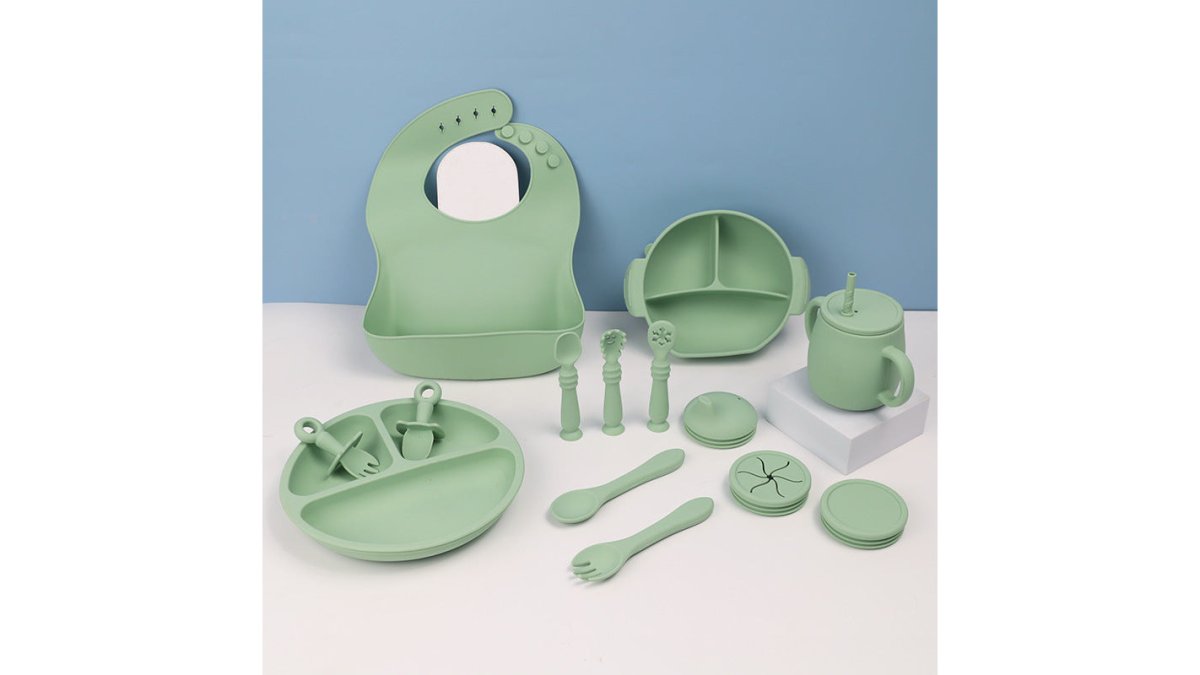
A few gear basics that make the first weeks calmer:

- A high chair with a 5-point harness and foot support
- A suction bowl or plate that stays on the tray
- A soft-tip baby spoon sized for a small mouth
For more on feeding milestones, the CDC milestones for feeding and swallowing is a solid reference to bookmark.
Conclusion: Your First Week of Solids
Here is a realistic first week:
- Day 1: One teaspoon of iron-fortified cereal mixed thin, once.
- Day 2: Same cereal, slightly thicker.
- Day 3: Mashed sweet potato, 1-2 tablespoons.
The first weeks are about practice, not portions. Keep it low-pressure, sit your baby upright, and let them set the pace.
At Modocam Kids, we stock the feeding essentials that make this stage easier, from suction-based tableware to bibs and cups, all in one place. Browse our feeding collection, add to cart, and get set up for a calmer start to solids.
Frequently Asked Questions
What are the signs baby is ready for solids?
Your baby is likely ready for solid foods when they can hold their head steady, sit upright with support, show interest in food by watching you eat or reaching for your plate, and have lost the tongue-thrust reflex that pushes food out of their mouth. Most babies show these signs around 6 months. The American Academy of Pediatrics recommends starting solids at about 6 months alongside breast milk or formula. If your baby was born prematurely, adjust for their corrected age and check with your pediatrician before starting.
What are the safest first foods for a baby?
Start with single-ingredient purees or soft mashed foods like cooked sweet potato, carrot, butternut squash, or infant cereal mixed with breast milk or formula. You can also offer soft finger foods such as ripe banana, avocado, or well-cooked broccoli florets. Introduce one new food at a time and wait two to three days before adding another so you can spot any reactions. Avoid honey, unpasteurized dairy, raw meat, raw seafood, and raw eggs. For a safe feeding setup, try a suction bowl like the Stainless Steel Silicone Baby Feeding Set Suction-Cup Baby Solid-Food Tray Bowl Fork And Spoon Dinnerware from Modocam Kids ($17.57) to keep the dish in place.
How do you prepare food to reduce choking risks for babies?
Cook vegetables until they are soft enough to mash with a fork. Cut finger foods into pieces no larger than a pea or a small fingernail for babies still learning to chew. Avoid round, firm foods like whole grapes, cherry tomatoes, and raw carrot sticks unless you quarter them lengthwise and cook them until soft. Remove all bones, seeds, and pits. Always seat your baby upright in a high chair with safety straps and supervise every bite. A non-slip plate like the Silicone Baby Dishes for Children's Tableware Plate Non-slip Baby Feeding Bowl from Modocam Kids ($21.27) can help keep food steady while your baby practices self-feeding.
How should you introduce common allergenic foods to a baby?
Introduce one allergen at a time, starting with a small amount mixed into a food your baby already tolerates. Common allergens include peanut, egg, dairy, wheat, soy, fish, and tree nuts. Offer the allergen at home, not at daycare or a restaurant, and wait 10 to 15 minutes to watch for reactions like hives, vomiting, or trouble breathing. If there is no reaction, continue offering that allergen two to three times per week to maintain tolerance. Talk to your pediatrician before introducing allergens if your baby has severe eczema or a known food allergy.

