

Cart
0
Table of Contents
- What Our Baby Gear Shipping Policy Covers
- Standard Shipping Methods and Delivery Windows
- Shipping Large Baby Items Cost: What Drives the Price
- Baby Gear Return Policy Best Practices
- Handling Damaged Baby Gear Shipments
- Shipping Restrictions, Tracking, and Insurance
- Conclusion
- Frequently Asked Questions
Last Updated: September 16, 2026
What Our Baby Gear Shipping Policy Covers
A high quality baby gear shipping policy is the written framework that explains how a retailer packs, ships, tracks, and delivers strollers, cribs, car seats, and other bulky infant products. At Modocam Kids, we are dedicated to ensuring your child's happy growth by providing products focused on comfort, care, and style, making us a convenient one-stop shop for all your growing family's needs.
Shipping a stroller is not the same as shipping a t-shirt. Package weight, dimensional weight, carrier surcharges, and delivery windows all change the math. Most store policy pages bury that reality under legal language. Ours does not.
Below, we break down how standard shipping works, what drives the cost of moving large items, how returns and damage claims are handled, and which restrictions apply before you click Add to Cart.
Standard Shipping Methods and Delivery Windows
Standard shipping is the default ground service most baby gear retailers use for everyday orders. Transit time typically runs several business days after the order leaves the warehouse, depending on your shipping zone and distance from the fulfillment center.
Here is how the main methods compare:
| Method | Typical Transit Time | Best For | Tracking Included |
|---|---|---|---|
| Standard ground shipping | Several business days | Most orders, non-urgent items | Yes |
| Expedited delivery | Faster than ground, shorter window | Gifts, imminent due dates | Yes |
| Overnight / express | Next business day in many zones | Last-minute essentials | Yes |
Order processing time is separate from transit time. A parcel does not start moving until it is picked, packed, and labeled, which usually takes one to two business days. Weekend orders often begin processing the next business day.
Free Shipping Thresholds and Expedited Options
Free shipping thresholds are the order totals that unlock complimentary standard shipping. Many retailers set a minimum cart value, and large items like strollers or cribs sometimes sit outside that threshold because of their size.
A common approach is to apply the threshold to smaller items, clothing, feeding products, and toys, while quoting large gear separately. If speed matters, expedited service shortens the delivery window but usually carries a surcharge. Always check the delivery estimate at checkout rather than assuming the fastest option is available for oversized parcels.
Shipping Large Baby Items Cost: What Drives the Price
Shipping large baby items cost comes down to four things: package weight, dimensional weight, shipping zone, and carrier surcharges. A crib box is light for its size, so carriers bill on the space it occupies, not just the scale reading.
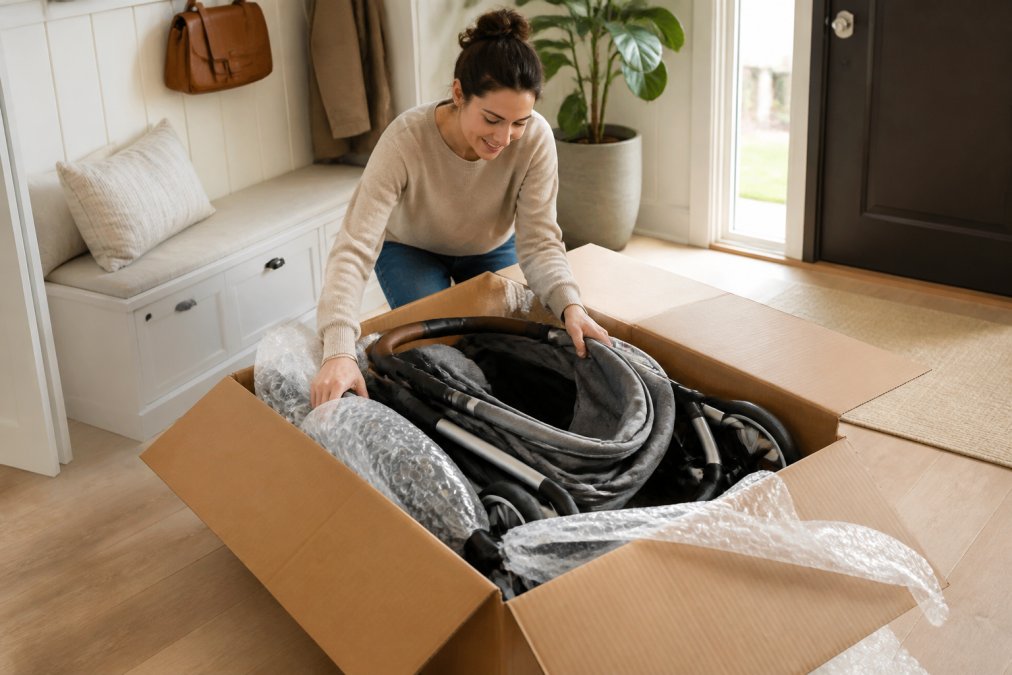
Here is what moves the number up or down:
- Dimensional weight: Bulky parcels are priced by volume. Carriers divide length × width × height by a dim divisor, commonly 139 for daily-rate parcel service, and bill whichever is greater, actual weight or dim weight. A crib carton that weighs 40 pounds but measures 60 × 40 × 12 inches bills as roughly 207 dim pounds, which is why the box, not the crib, sets the rate.
- Shipping zone: Rates rise by zone, measured from the fulfillment center to the delivery address. A stroller shipped three zones away can cost noticeably more than the same stroller shipped locally, even at identical weight.
- Surcharges: Oversize, additional-handling, residential, delivery-area, and peak-season fees stack on top of the base rate. An oversize surcharge alone can exceed the base rate on a jogging stroller.
- Freight vs. parcel: Once a shipment crosses the carrier's oversize thresholds, it may move as LTL freight instead of parcel. Freight adds its own vocabulary, freight class, liftgate service, residential delivery, and appointment windows, and each is a line item.
Pro Tip
Before ordering a large item, measure your doorway and stairwell, not just the room. A stroller or crib that fits the nursery can still get stuck at the front door, and that is a delivery problem no carrier can solve for you.
Threshold, Curbside, and White-Glove Delivery
Most oversized gear ships one of three ways, and the difference matters more than the price:
| Service level | What happens | Who moves the box |
|---|---|---|
| Threshold | Carrier leaves the carton just inside the first dry area | You |
| Curbside / liftgate | Freight truck lowers the pallet at the curb or driveway | You |
| White-glove | Crew carries the item to the room, unpacks it, and removes debris | The delivery crew |
White-glove delivery is the gap most shipping policies skip.
Baby Gear Return Policy Best Practices
A strong return policy answers three questions: how long you have, what condition the item must be in, and who pays return shipping.
Best practices for return policies often include:
- State the return window in plain days, not "promptly."
- Require a return authorization before the item ships back.
- Explain restocking fees clearly, and only apply them where genuinely necessary.
- Offer a clear path for defective or damaged items that skips the standard return queue.
Handling Damaged Baby Gear Shipments
- Photograph the box and the damage before unpacking further.
- Keep all packing materials until the claim is resolved.
- Contact the retailer with your order number and photos.
- File the claim within the carrier's stated window, which is often short.
Watch Out
Signing for a delivery without noting visible damage can weaken your claim. If the driver is still there, write "damaged" on the signature pad. It takes ten seconds and protects you later.
Insured shipping covers loss and damage up to a declared value. For high-value gear like premium strollers, confirm the shipment is insured before it leaves the warehouse.
Shipping Restrictions, Tracking, and Insurance
Shipping restrictions apply to certain destinations and items. Remote areas, some islands, and international addresses may fall outside standard ground shipping zones, and oversized gear may not be deliverable to every location.
Here is what to expect:
- Alaska and Hawaii: Ground parcel service is limited or unavailable to many ZIP codes; air service may apply with a surcharge, and oversized items may be excluded entirely.
- International shipping: Duties, customs delays, and different return rules apply, and not every item can ship abroad. The recipient is typically the importer of record and owes any duty or tax.
- P.O. boxes and APO/FPO addresses: Size and weight limits block most large parcels, so cribs and strollers generally need a street address.
- Remote and delivery-area ZIP codes: Carriers publish lists of ZIP codes that trigger a delivery-area surcharge or fall outside standard service.
Key Takeaway
A tracking number confirms the parcel exists, not that it is moving. If the status sits unchanged for several business days, that is your signal to reach out, not to wait.
Who Is Liable When Gear Arrives Damaged
This is a question that matters for high-value items. Under the default rules most carriers publish, liability for loss or damage is capped unless the shipper declares a higher value and pays for it. That means the retailer's choice of declared value, not the price you paid, can set the ceiling on a claim.
A few practical points:
- Declared value vs. carrier default liability: Declaring the full retail value costs extra, but it is what makes a damaged premium item whole instead of partially reimbursed.
- Who files the claim: The shipper (the retailer) usually holds the carrier contract, so the retailer files and the customer documents. Keep photos and the carton until the claim closes.
- Signature requirements: High-value shipments often require an adult signature. If you waive it, you may also waive the easiest path to a damage claim.
- Time limits: Carrier claim windows are short, often measured in days from delivery, not weeks. Report damage the day it arrives.
Gift Shipping: Packing Slips and Presentation
Baby gear is frequently bought as a gift, and standard shipping rarely accounts for it. Two details to confirm before ordering:
- Price hiding: Ask whether the packing slip prints prices. Many retailers can suppress pricing on gift orders so the recipient sees the item, not the invoice.
- Gift messaging and wrap: Gift notes and gift wrap are often unavailable on oversized items because the original carton is the shipping container. If presentation matters, ship the gift to yourself and hand-deliver it.
- Registry and gift receipts: A gift receipt lets the recipient exchange without seeing the purchase price, which matters on items with hygiene or safety return restrictions.
Conclusion
Shipping bulky baby gear requires a policy that is transparent about cost drivers, clear about restrictions, and provides a process for resolving damage or returns.
Frequently Asked Questions
How much does it typically cost to ship large baby gear like strollers?
Shipping large baby gear costs depend on package weight, dimensional weight, shipping zone, and carrier surcharges. Strollers and furniture often ship via freight rather than standard parcel, which adds cost. At Modocam Kids, pricing depends on the item, delivery address, and chosen service level. Check the product page or your cart for an exact shipping quote before you order.
What should I look for in a retailer's shipping policy for baby furniture?
Look for clear processing times, transit day estimates, and whether the carrier handles freight or parcel delivery. Check the shipping threshold for free delivery, restrictions for Hawaii and Alaska, and whether white-glove or assembly service is available. A strong baby gear shipping policy also explains how to file a claim for shipping damage and how to get a return authorization if something arrives wrong.
Do premium baby gear retailers offer free shipping on large items?
Many premium retailers set a free shipping threshold that applies to standard ground shipping on eligible items. Large items like strollers or furniture may be excluded or require a freight surcharge. Modocam Kids lists any exclusions on the product page so you know before checkout. Expedited delivery and white-glove assembly are typically add-on services.
What is the standard return window for high-quality baby gear?
Most high-quality baby gear retailers offer a return window between 30 and 90 days from delivery. Items must be unused and in original packaging. Some products, like car seats or opened feeding items, may have restocking fees or be non-returnable for safety reasons. Always request a return authorization before sending anything back, and keep the original shipping label and packaging until you confirm the item works for your family.

