

Cart
0
Table of Contents
- The Real Cost of Cheap Baby Gear
- Why Premium Baby Gear Is Worth the Investment: A Cost-Per-Use Breakdown
- Safety Certifications and Crash Test Ratings That Matter
- Best Durable Baby Strollers for 2026: What Sets Them Apart
- When to Splurge on Baby Gear (and When to Save)
- Resale Value of Premium Baby Gear: What You Get Back
- Warranty Coverage, Insurance, and Customer Support
- The Environmental and Psychological Case for Buying Better
- Frequently Asked Questions
Last Updated: September 16, 2026
The Real Cost of Cheap Baby Gear
A $40 stroller that fails after eight months costs more per month than a $400 stroller that lasts four years. That math is the case for why premium baby gear is worth the investment. This guide covers cost-per-use, safety certification, resale value, and where spending more pays you back.
Watch Out
The hidden cost of budget gear isn't the purchase price. It's the replacement cycle. Two cheap strollers in three years typically outspend one durable stroller that holds its value, and the second purchase usually happens during a season when you have the least time to research it.
Why Premium Baby Gear Is Worth the Investment: A Cost-Per-Use Breakdown
Premium baby gear is worth the investment when its cost-per-use falls below the cheaper alternative over the same period. A stroller used daily for three years delivers thousands of uses; one used twice a month does not.
How to Calculate Cost-Per-Use for Any Item
Divide the purchase price by the number of times you expect to use the item before it wears out or your child outgrows it.
| Item | Typical Usage | What Drives Longevity | Splurge or Save |
|---|---|---|---|
| Stroller | Daily, 2-4 years | Frame material, suspension, fold mechanism | Splurge |
| Car seat | Daily, until outgrown | Safety certification, weight capacity | Splurge |
| High chair | 3x daily, 2-3 years | Ease of cleaning, adjustability | Splurge |
| Baby carrier | Daily, 12-18 months | Ergonomic design, parental comfort | Splurge |
| Newborn clothing | Weeks per size | Non-toxic materials, durability | Save |
| Burp cloths, bibs | Daily, months | Absorbency, wear and tear | Save |
Safety Certifications and Crash Test Ratings That Matter
Safety certification is the non-negotiable baseline, and it's where budget gear most often cuts corners quietly. In the United States, car seats must meet Federal Motor Vehicle Safety Standard 213, and the National Highway Traffic Safety Administration publishes crash test ratings and recall data parents can check directly through NHTSA child seat ratings and recall database.
Best Durable Baby Strollers for 2026: What Sets Them Apart
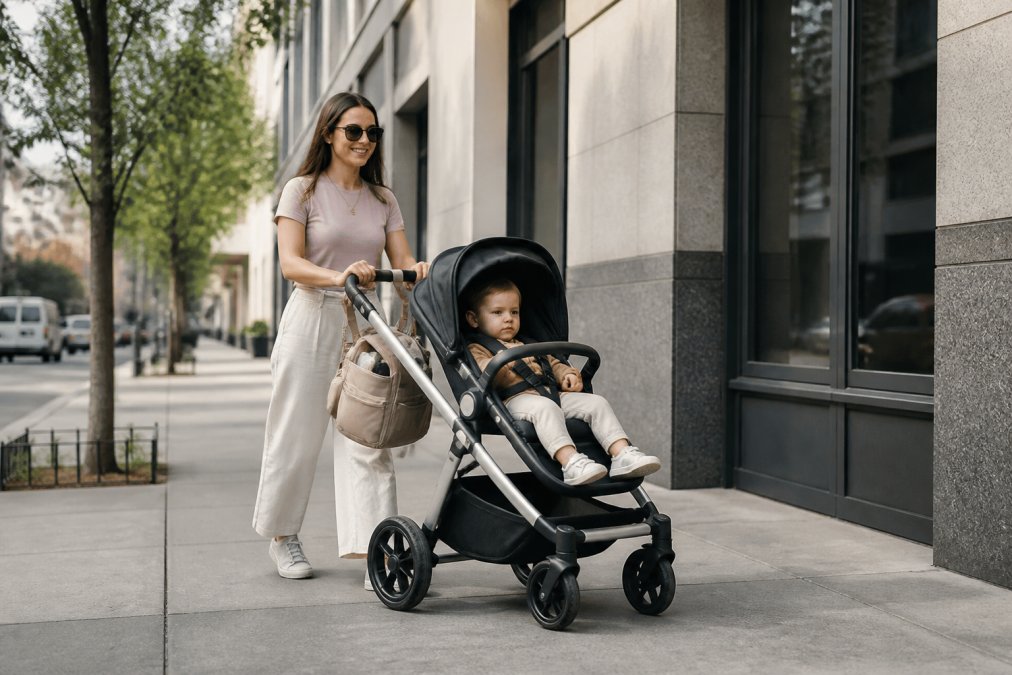
The best durable baby strollers for 2026 share a recognizable engineering profile: an aluminum or magnesium alloy frame, serviceable wheels with sealed bearings, real suspension at one or both axles, a fold mechanism rated for thousands of cycles, and a published weight capacity that carries a child past the toddler stage. Everything else, fabric color, canopy shape, cup holder count, is preference.
Frame Materials, Suspension, and Fold Mechanisms
Frame material decides how the stroller ages. Aluminum resists corrosion, stays light, and is the default for mid-range and premium strollers. Steel is heavier and cheaper, the usual choice on budget models, the weight penalty shows up every time you lift it into a trunk. Magnesium alloy sits between them on weight with excellent rigidity, reserved for premium lightweight models.
How to Evaluate a Stroller Before You Buy
A short pre-purchase checklist that separates durable strollers from disposable ones:
- Published weight and height limits. If the manufacturer won't state them clearly, that's a signal.
- Serviceable parts. Can you order a replacement wheel, canopy, or harness without buying a new stroller?
- Fold rating. Look for a stated cycle count, or at minimum metal hinges and a positive lock.
- Suspension type. Front-only for sidewalks, all-wheel for mixed terrain, none only if you never leave smooth pavement.
- Warranty length on frame and mechanism. A longer frame warranty signals the manufacturer expects the product to survive normal use.
- Certification seal. Strollers sold in the United States are typically built to ASTM F833, and a Juvenile Products Manufacturers Association seal indicates verified compliance.
Pro Tip
Bring a bag of groceries or a weighted diaper bag to the store and load the stroller before you buy. Push it one-handed around a corner. Fold it twice. The features that matter most, fold effort, push effort, and stability under load, only show up when the stroller is actually weighted.
Matching the Stroller to Your Actual Life
The stroller that lasts longest is the one you'll actually use. A daily urban commuter benefits from a compact one-hand fold and front suspension. A suburban parent loading a trunk twice a day benefits from low weight and a fold that stays locked. A trail walker benefits from all-wheel suspension and pneumatic tires. Buying a heavy all-terrain stroller for sidewalk life means you'll leave it in the garage and reach for a cheap umbrella stroller, defeating the cost-per-use argument.
When to Splurge on Baby Gear (and When to Save)
Splurge on gear that touches your child's body daily or carries their weight. Save on gear your child outgrows in weeks.
Items Worth the Premium vs. Items That Aren't
Worth the premium:
- Car seats and strollers (safety certification, daily use, resale value)
- Baby carriers (ergonomic design, parental comfort, infant development)
- High chairs (ease of cleaning, adjustability, multi-functional use)
- Cribs and mattresses (non-toxic materials, long-term investment)
Not worth the premium:
- Newborn clothing in sizes worn for a few weeks
- Trend-driven nursery decor
- Single-purpose gadgets that duplicate something you own
Pro Tip
Apply the "hours of contact" test. If your child will touch, sit in, ride in, or sleep on an item for more than an hour a day, the quality difference shows up fast. If it's used for twenty minutes a week, the premium rarely justifies itself.
Resale Value of Premium Baby Gear: What You Get Back
The resale value of premium baby gear is the most underrated argument for buying better. Recognized brands with strong safety reputations and durable materials hold value in the second-hand market far better than no-name equivalents.
Warranty Coverage, Insurance, and Customer Support
Warranty coverage is where premium brands separate from budget ones. A longer warranty on frame and mechanism signals the manufacturer expects the product to survive normal use.
The Environmental and Psychological Case for Buying Better
Most guides frame premium baby gear as a luxury decision. Two angles make the stronger case: the environmental lifecycle of durable goods, and the psychological load poorly designed gear places on parents every day.
Durability as a Sustainability Strategy
Durability is a sustainability strategy, and the math is straightforward. Every stroller that lasts four years instead of one keeps roughly three additional units of plastic, foam, aluminum, and textile out of the waste stream. Multiply that across a car seat, high chair, carrier, and crib, and one family's gear decisions shape a meaningful volume of material over a child's first five years.
Key Takeaway
A stroller that serves three children across seven years has roughly one-third the material footprint per child of a stroller replaced every two years. Durability isn't just a financial argument, it's the most practical environmental decision a parent makes in the gear category.
Resale Logistics: Turning "Investment" Into a Literal Calculation
If premium gear is an investment, treat it like one. Resale recovery is where the financial case becomes concrete.
What drives resale value on premium gear:
- Original packaging and receipt. Listings with the original box and proof of purchase sell faster and command higher prices than identical models without them.
- Service history. A stroller with documented wheel or canopy replacements, or a record of professional cleaning, reads as maintained rather than used up.
- Completeness. Original harness pads, canopies, bassinet attachments, and adapters all raise the price. Missing accessories are the most common reason a listing sits unsold.
- Cleanliness. Fabric that's been spot-treated and air-dried, not machine-washed and shrunk, holds value. Most premium stroller fabrics are removable and washable, check before you buy.
- Timing. List gear in late winter and early spring, when expectant parents are actively shopping, rather than in the middle of the holiday season when listings flood the market.
The Psychological Impact of Gear
The psychological impact of gear is the angle competitors skip, and the one parents feel most. A stroller that folds one-handed while you hold a toddler, a carrier that doesn't strain your lower back after twenty minutes, a high chair that wipes clean in ten seconds: these remove small daily frictions that compound into parental stress.
Frequently Asked Questions
Are expensive baby strollers worth the higher price point?
Premium strollers often cost more upfront, but they deliver better maneuverability, stronger frames, and longer warranty coverage. When you calculate cost-per-use across two or three children, the daily expense can drop below that of a budget stroller replaced every year. Resale value also matters: high-end brands hold 40-60% of their retail price on the second-hand market, while budget models often sell for very little. The key is matching the stroller's features to your actual daily routine and storage space.
What features should I look for in premium baby gear?
Prioritize safety certification, material quality, and adjustability. Check for JPMA certification or ASTM standards compliance. Look at weight capacity, fold mechanism, and whether the product grows with your child. Non-toxic materials matter for items your baby mouths or sleeps in. For strollers, test the suspension and one-hand fold. For high chairs, check ease of cleaning and harness security. Warranty coverage and customer support are also strong signals of a brand's confidence in its products.
Is it better to buy new premium gear or used budget items?
It depends on the item. For car seats, always buy new, since you cannot verify crash history or expiration. For strollers, high chairs, and carriers, a used premium item in good condition often beats a new budget model because the materials and engineering last longer. Inspect used gear for wear and tear, check for recalls, and confirm all parts are included. The resale value of premium baby gear means you can often recoup a significant portion of your cost when you're done.
How do I know premium baby gear is actually durable and not just marked up?
Look for specific indicators: metal frames instead of plastic, replaceable parts, and a warranty longer than one year. Read the weight capacity and compare it to cheaper alternatives. Check whether the brand publishes safety certification details. Material quality shows in stitching, fabric weight, and hardware. Brands that offer replacement parts and responsive customer support are usually confident in their durability. Reviews mentioning multi-year use across siblings are a good sign.
Buying well once takes more research upfront than buying cheap twice, and that's the real barrier for most parents. Modocam Kids curates premium baby and kids essentials across strollers, maternity gear, feeding products, and clothing, so safety details and specifications live on the product page instead of in a forum thread. Our focus is comfort, care, and style for every stage, from newborn to toddler, in one place. Get started with Modocam Kids and build a registry that holds its value.

