

Cart
0

Last Updated: October 30, 2026
Quick Summary
Safe sleep tips for two babies start with two separate sleep spaces: each twin needs their own firm, flat surface with a fitted sheet and nothing loose, never a shared crib or bed. Keep at least 12 inches between the two surfaces, dress each baby for the room, and tag-team night feeds so neither parent handles both infants alone.
- Twins should never share a crib or bassinet; each baby needs a separate, safety-approved surface.
- Leave at least 12 inches between the two sleep surfaces and keep both a foot from heaters and cords.
- Dress each infant in one extra layer beyond what you would wear and check the back of the neck.
- Stop swaddling once either baby shows signs of rolling, and check both babies at every change.
- Run the 20 to 30 minute bedtime routine in parallel, not one baby at a time.
Table of Contents
- Why Safe Sleep Rules Change When You Have Two Babies
- Can Twins Sleep in the Same Crib? What the Guidance Says
- Building a Safe Sleep Environment for Babies Times Two
- The Seven Safe Sleep Tips That Matter Most With Two
- How to Build a Twin Baby Sleep Schedule That Actually Holds
- A Nighttime Routine for Twins That Keeps Every Sleep Safe
- Gear That Supports Safer Sleep for Two
- Setting Up Your Twin Sleep Space Before Delivery Day
- Frequently Asked Questions
Why Safe Sleep Rules Change When You Have Two Babies
Safe sleep tips for two babies start with one uncomfortable truth: the rules do not change, but everything around them does. The American Academy of Pediatrics still says babies sleep safest alone, on their backs, on a firm flat surface, with nothing loose in the sleep space. What changes is the logistics: two surfaces, two temperature checks, and twice the chances a relative drops a blanket into the wrong crib.
That is why so many parents quietly bend the rules at 3 a.m.
Below, we cover the seven safe sleep tips that matter most with twins, plus a nighttime routine you can keep.
Can Twins Sleep in the Same Crib? What the Guidance Says
No. Twins should not share a crib or bassinet. The AAP recommends each infant sleep in their own separate, safety-approved surface with a firm mattress and a fitted sheet, and that guidance applies whether you have one baby or two.
The temptation is understandable. Newborn twins often settle faster when they can sense each other, and one shared bassinet takes up half the floor space.
Safe sleep for twins means two separate sleep spaces, side by side or across the room, never one shared surface. If space is tight, place two compact bassinets or portable cribs next to each other rather than combining them. The AAP safe sleep recommendations are the clearest plain-language version for parents setting up a nursery.
Building a Safe Sleep Environment for Babies Times Two
A safe sleep environment for babies comes down to four things: a firm flat surface, a fitted sheet, nothing else in the sleep space, and consistent room temperature. Duplicate all four, then resist the urge to decorate the second crib differently. The part most guides skip is fitting two compliant sleep spaces into one room without compromising any of the four.
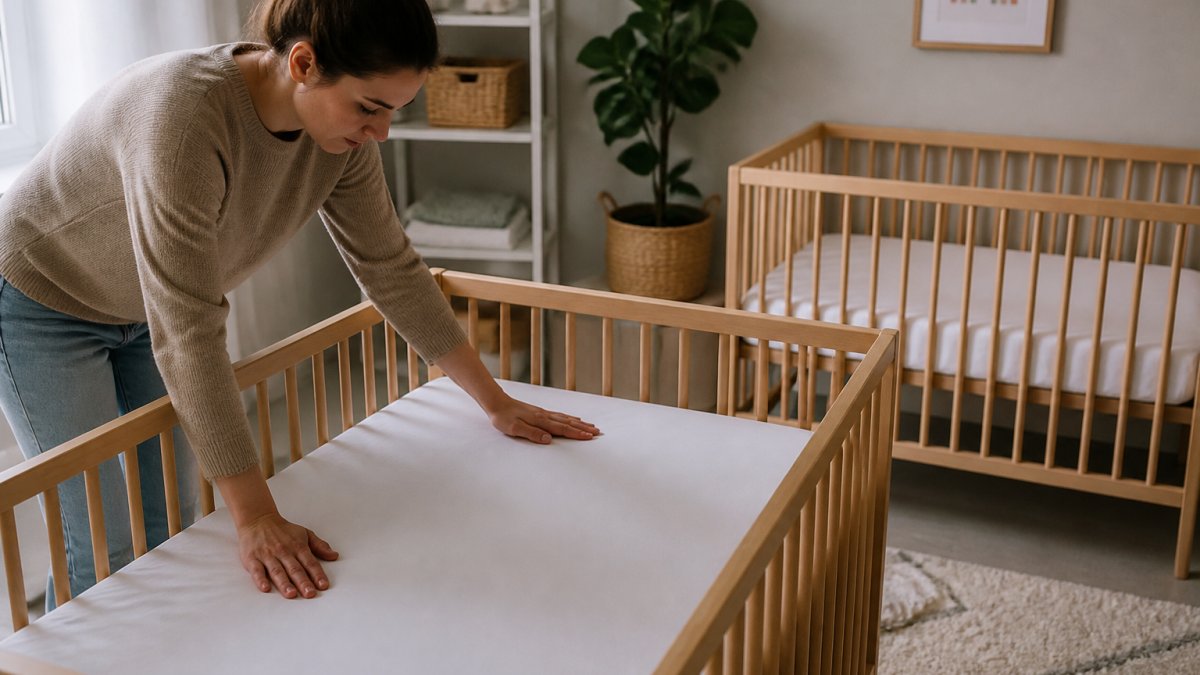
Separate Surfaces, Clear Spaces
Each baby needs a crib, bassinet, or play yard that meets current safety standards, with a mattress that fits snugly and no gaps at the edges. The test is simple: if you can fit more than two fingers between the mattress and the crib side, the mattress is too small.
Keep both sleep spaces bare. No bumpers, pillows, stuffed animals, or loose blankets, not even for a nap.
Leave at least 12 inches between the two sleep surfaces so you can reach in one-handed without brushing the other crib, and keep both at least a foot from any wall heater, radiator, or window covering with a cord. If the room is tight, place the cribs along the same wall rather than facing each other.
Temperature, Clothing, and Swaddle Choices
Overheating is a real risk, and two babies in one small room raise the temperature faster than you expect. Dress each infant in one extra layer beyond what you would wear, and check the back of the neck rather than the hands or feet. A common target is roughly 68 to 72 degrees Fahrenheit; a small wall thermometer beats guessing.
Swaddling helps newborns feel secure, but it needs to be done correctly: snug across the chest, loose at the hips, and stopped as soon as a baby shows signs of rolling. Our baby sleeping bag envelope for newborns is made with a 100% cotton inner layer, and the quilted sleeping bag wrapper is made from a cotton blend with a cotton fiber lining. If you are still deciding, our guide to swaddle versus wrap differences explains which suits which baby.


Watch out: a swaddle that comes loose during the night can ride up over the face. Check the fastening every time, and stop swaddling entirely once either baby starts trying to roll. Because twins often hit milestones on different timelines, check both babies at every change.
Key Takeaway
Two safe sleep spaces are not just one setup duplicated. Measure the mattress-to-crib gap, leave at least 12 inches between surfaces, keep cords and heat sources clear, and label each sleep bag so the right one reaches the right baby in the dark.
The Seven Safe Sleep Tips That Matter Most With Two
These are the safe sleep tips we would give any twin parent, in the order they matter:
- Back to sleep, every sleep. Every nap, every night, both babies. Once a baby can roll both ways on their own, you can stop repositioning them.
- One firm, flat surface per baby. No inclined sleepers, no car seats used as beds, no propped-up mattresses.
- Keep both sleep spaces bare. Fitted sheet only. No toys, no positioners, no blankets.
- Share the room, not the bed. Room-sharing for the first months is recommended. Bed-sharing between the twins, or between a parent and a baby on a soft surface, is not.
- Feed each baby upright and burp well. Falling asleep with a bottle in the mouth raises choking and ear infection risks.
- Dress for the room, not the season. Two babies in a small nursery heat it up quickly. Check the back of the neck.
- Tag-team the night feeds. One parent per baby, in separate spots, so neither of you is holding two infants on a sofa at 4 a.m.
That last one is the tip nobody puts on a checklist. Most twin sleep accidents start with exhaustion, not neglect. Plan the night shift in advance so neither parent is improvising while half asleep.
How to Build a Twin Baby Sleep Schedule That Actually Holds
A twin baby sleep schedule works best when it is built around one anchor: the first morning feed.
From there, watch for sleepy cues rather than the clock. Yawning, turning away, and rubbing eyes mean a wake window is closing.
Baby Removable And Washable Bed Crib Portable Crib Travel Bed For Children →
| Time Block | What Happens | Why It Matters |
|---|---|---|
| Morning anchor | Wake both, feed together | Sets the day's rhythm |
| First nap | Both down within 15 minutes of each other | Protects your own rest window |
| Midday feed | Feed together, then wake windows | Keeps the schedule from drifting |
| Afternoon nap | Same routine, same spaces | Reinforces the sleep association |
| Bedtime | Bath, feed, sleep bag, own crib | Ends the day the same way every night |
Naps will drift apart during growth spurts. Do not fight it. Protect the bedtime routine instead, because that is the part that holds when everything else falls apart.
A Nighttime Routine for Twins That Keeps Every Sleep Safe
A nighttime routine for twins should be short, identical for both babies, and finished before either one is fully asleep.
Run the routine in parallel, not in sequence. Bathe one while your partner feeds the other, then swap.
Keep the room dim and the voices low from the first step.
Watch out: the "just this once" transfer into your bed during a rough night is how most twin parents end up bed-sharing by month three.
Gear That Supports Safer Sleep for Two
Gear does not make sleep safe on its own, but the right pieces remove the excuses. Two separate sleep surfaces, two sleep bags, and a portable option for travel cover most of what a twin household needs.
Sleep Surfaces: What to Check Before You Buy
For each baby, you need a crib, bassinet, or play yard that meets current safety standards. When you compare options, look past the marketing and check four things:
- Mattress fit and firmness. The mattress should be firm enough that it does not indent around a baby's head, and it should fit the frame with no more than a two-finger gap. A mattress that came with a used crib may not match the frame; measure both.
- Frame material and finish. Wood and metal frames are both common. Look for a smooth, non-toxic finish with no peeling edges, and check that folding joints lock firmly with no pinch point.
- Cover care. Removable, washable covers matter more with two babies, because spit-up and diaper leaks double. Check whether the cover is machine washable and whether it can go in the dryer or must air-dry.
Our portable cotton crib is a foldable, portable option made of cotton, and its cover is removable and washable. Our foldable baby bed net set includes a mattress and pillow, and is foldable for easy storage. If you are still comparing travel sleep surfaces,
Sleep Bags and Swaddles: Care and Longevity
Sleep bags take a beating. With twins, you may be washing two bags every couple of days, so check the care label before you commit. Follow the care label on each bag and air-dry when you can.
Size matters as much as material. A sleep bag that is too large can let a baby slip down inside it, and one that is too small restricts movement.
What Not to Buy
What we would not buy: inclined sleepers, crib bumpers, and any product marketed as reducing the risk of SIDS. the Consumer Product Safety Commission guidance on infant sleep products explains which products are regulated and which are not. If a product's main selling point is that it keeps a baby from rolling or keeps them 'contained,' treat that as a warning sign rather than a feature.
Pro Tip
Before delivery day, wash every sheet, sleep bag, and cover once according to its care label. You will learn which pieces shrink, which zippers snag, and which covers need air-drying, all before you are doing laundry at 2 a.m. with two newborns.
Setting Up Your Twin Sleep Space Before Delivery Day
Set up both sleep spaces at least four weeks before your due date, because twins often arrive early. Assemble each crib or bassinet, confirm the mattress fits with no gaps, wash and fit both sheets, and place the two surfaces far enough apart that you can walk between them.
Then run a test night. Put a doll or a rolled towel in each space, dim the lights, and walk through your nighttime routine start to finish.
Two babies mean double the sleep surfaces, double the temperature checks, and double the chances a tired parent shortcuts the rules at 2 a.m. The fix is preparation, not willpower: separate firm surfaces, bare cribs, sleep bags you can tell apart in the dark, and a routine you can run on autopilot. Modocam Kids offers a range of baby and kids essentials, including sleep bags and portable cribs, focused on comfort and care.
Frequently Asked Questions
Can twins sleep in the same crib?
No. The American Academy of Pediatrics recommends each baby sleep alone on a separate, firm, flat surface with nothing else in it. Two babies in one crib can roll into each other, overheat, and block each other's breathing space, and the mattress may not support both weights evenly. Keep two separate bassinets or cribs side by side instead. If space is tight, place them a safe distance apart rather than pushing them together, and never use a divider as a substitute for separate surfaces.
Do twins need separate sleep surfaces from day one?
Yes, from the first night home. Two separate bassinets or cribs give each baby their own firm, flat surface and clear airflow, which is the core of safe sleep tips for two babies. Many parents place the two bassinets close enough to reach both from one spot for night feeds. Once either baby can roll, sits up, or pushes up on their hands, move both to cribs so neither can tip or climb out of a smaller bassinet.
How do I keep a twin baby sleep schedule without unsafe sleep props?
Build the schedule around feeding times, then layer sleep on top. Wake both babies for feeds at the same time, keep the room dark and quiet at night, and use brief, boring interactions during night feeds so neither baby fully wakes. Avoid swings, loungers, and inclined seats for overnight sleep, since these are not safe sleep surfaces. A consistent eat-wake-sleep pattern, even loosely followed, helps both babies settle faster within a few weeks.
What does a safe sleep environment for babies look like in a shared room?
A firm, flat mattress with a fitted sheet, nothing else in the sleep space, and a room kept at a comfortable temperature with steady airflow. Keep the two sleep surfaces apart rather than touching, and skip pillows, blankets, bumpers, and stuffed toys. A breathable mesh option, such as the Foldable Baby Bed Net With Pillow Net 2-Piece Set, can add airflow and insect protection for daytime naps or travel, but overnight sleep should still happen on a separate, flat, firm surface for each baby.
How can I manage nighttime feeds with two babies while keeping sleep safe?
Feed each baby in an upright, awake position and put them back on their own flat surface drowsy but not asleep. Never feed a baby on a sofa or soft chair where you might doze off, and never prop a bottle. If you feed both at once, set up a chair with both babies within reach and a firm surface nearby to place each one down after burping. Keep the room dim and avoid eye contact and play so both babies learn night is for sleep.


