

Cart
0

Table of Contents
- Why Sleepless Nights With a Newborn Happen
- Safe Sleep Practices for Infants That Also Protect Your Rest
- How to Manage Parental Sleep Deprivation Without Falling Apart
- When Do Babies Sleep Through the Night?
- Building a Calming Bedtime Routine for Everyone
- Postpartum Recovery, Mental Health, and When to Ask for Help
- Frequently Asked Questions
Last Updated: September 29, 2026
Why Sleepless Nights With a Newborn Happen
Newborns wake often because their sleep cycles are short and their stomachs are small. Most infants need to eat every two to three hours, day and night, for the first several weeks. This is normal.
Knowing how to deal with sleepless nights with a newborn starts with accepting one fact: your baby is not broken, and neither are you.
Newborn sleep looks nothing like adult sleep. Babies spend more time in light sleep, which makes them easy to rouse. They also have no sense of day versus night yet. That rhythm builds slowly over the first few months.
At Modocam Kids, tired parents ask us every week: "When does this get easier?" The honest answer is that it comes in stages, not overnight.
A few things drive the wake-ups:
- Hunger, since tiny stomachs empty fast
- A need for comfort and closeness
- An immature internal clock
- Growth spurts that spike appetite
The first weeks are the hardest. But small changes to your setup and your schedule can protect your rest.
Safe Sleep Practices for Infants That Also Protect Your Rest
Safe sleep and parent rest are not opposites. A safe, predictable sleep space helps your baby settle faster, meaning fewer middle-of-the-night rescues for you.
The American Academy of Pediatrics safe sleep recommendations are the standard to follow. The core rules are simple and worth repeating.
Setting Up a Safe Sleep Space
Place your baby on their back for every sleep. Use a firm mattress with a fitted sheet. Keep the crib or bassinet free of pillows, blankets, bumpers, and toys.
A portable option can help. The Baby Removable And Washable Bed Crib uses a cotton, foldable design that keeps a consistent sleep spot at home or away, which can mean less protest at bedtime.

Room-sharing is another tool. The AAP suggests keeping your baby in your room, on a separate surface, for at least the first six months (How to Keep Your Sleeping Baby Safe: AAP Policy Explained). You will wake for feeds either way, but you will not walk down a hallway at 3 a.m.
Drowsy but Awake: Helping Your Baby Self-Settle
"Drowsy but awake" means putting your baby down before they are fully asleep so they practice falling asleep on their own. Start with the first nap of the day, when babies have the most patience. If it fails, try again at the next one. This skill takes weeks, not days.
How to Manage Parental Sleep Deprivation Without Falling Apart
You cannot bank sleep, but you can protect it. Stop chasing one long stretch and start stacking shorter ones. A 90-minute block of consolidated sleep does more for you than three 30-minute fragments, because your body cycles through deeper sleep stages in roughly 90-minute waves.
A common mistake is treating night wakings as a two-person job.
Sharing Nighttime Duties With a Partner
Split the night into shifts. One parent takes the hours before 2 a.m., the other takes everything after. Each person gets one solid block instead of two broken ones.
- Feed, change, and resettle in one wake-up instead of three separate trips
- Keep everything you need within arm's reach of the bed or chair
- Trade a night with a trusted family member or friend once a week if you can
- Nap in the morning when someone else can watch the baby, even for 45 minutes
A few ground rules that work:
- Decide shifts before bedtime, not at 2 a.m.
- Keep the lights dim and voices low
- Do not check your phone during your shift
- Trade off on weekends so one person can sleep in
Nighttime Sensory Management for Easier Wake-Ups
Your senses take a beating at night. Bright light and loud sound jolt you awake and make it hard to fall back asleep. Managing your sleep environment is one of the most overlooked levers parents have.
3.2 Inch Digital Baby Care Device →
Pro Tip
Keep a "night kit" by your bed: water, a snack, burp cloths, and a spare pacifier. Every trip you avoid is minutes of sleep you keep.
Caffeine: Use It, Do Not Lean on It
Caffeine peaks in 30 to 60 minutes and has a half-life of roughly five hours, so a cup at 4 p.m. can still be in your system at 9 p.m. If you are breastfeeding, most guidance suggests keeping intake moderate, about 200 to 300 milligrams a day, and timing it early. Use caffeine as a morning tool, not an all-day crutch, and stop by early afternoon.
When Do Babies Sleep Through the Night?
There is no single answer, but most babies start sleeping longer stretches between three and six months. Some get there sooner. Others take closer to a year.
Typical Newborn Sleep Patterns by Month
| Age | Total Sleep | Longest Stretch | Night Feeds |
|---|---|---|---|
| 0-1 month | 14-17 hours | 2-3 hours | 3-4 |
| 1-2 months | 14-16 hours | 3-4 hours | 2-3 |
| 3-4 months | 14-16 hours | 5-6 hours | 1-2 |
| 5-6 months | 12-15 hours | 6-8 hours | 0-1 |
These are general patterns, not rules. Premature babies and babies with feeding issues often follow a slower curve.
Sleep Regressions and What They Mean for Your Nights
A sleep regression is a stretch when a baby who was sleeping well suddenly wakes more. They tend to hit around four months, eight months, and again near a year. The four-month regression is the big one, it reflects a real change in how your baby's brain handles sleep cycles, a sign of development, not a step backward. Regressions usually ease within two to four weeks.
Building a Calming Bedtime Routine for Everyone
A bedtime routine signals to your baby that sleep is coming and gives you a predictable end to the day, which matters when you are running on empty.
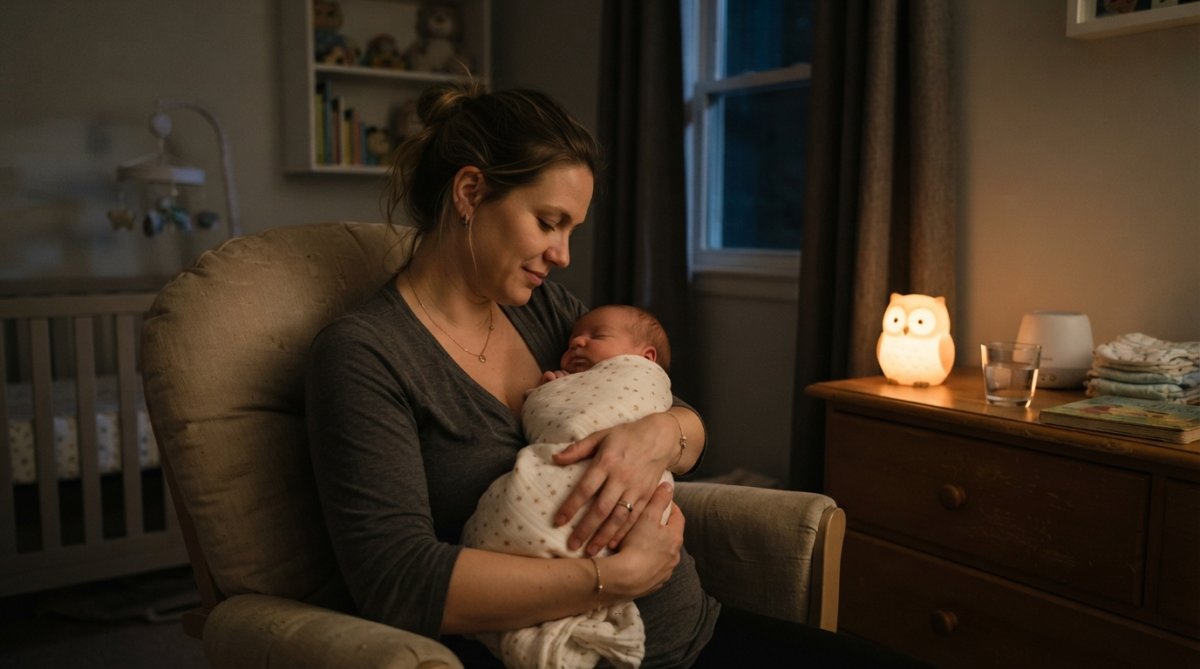
A routine that works for most families:
- Give a warm bath or sponge bath
- Put on a fresh diaper and pajamas
- Feed in a dim room
- Read one short book or sing one song
- Lay your baby down drowsy but awake
Watch Out
Do not add new steps when your baby is already overtired. A fussy baby will fight a long routine. Keep it brief and get them down.
Postpartum Recovery, Mental Health, and When to Ask for Help
Sleep loss is not just a nuisance. It affects how you heal, how you think, and how you feel. Ignoring it does not make it go away.
Sleep Deprivation and Physical Recovery
Exhaustion is not just a mood problem; it is a physical one. During deep sleep, your body releases growth hormone and does much of its tissue repair. When that sleep is fragmented night after night, recovery slows.
Postpartum Mental Health Red Flags
Some fatigue is normal; some is a warning sign. The line between the two is not how tired you are, it is how the tiredness behaves. Normal newborn exhaustion lifts when you get rest. Postpartum depression and anxiety do not; they persist, with symptoms rest alone does not fix.
Talk to a doctor if you notice:
- Sadness or hopelessness that lasts more than two weeks
- No interest in your baby or in things you used to enjoy
- Trouble sleeping even when your baby is asleep
- Racing thoughts or panic attacks
- Intrusive, frightening thoughts you cannot shake
- Thoughts of harming yourself or your baby
Building Your Support System
You cannot do this alone, and you should not try. Line up help before you need it.
A few ways to build support:
- Accept every meal offer
- Hire a postpartum doula if your budget allows
- Join a new-parent group, in person or online
- Ask your partner to take one full night a week
Key Takeaway
Sleep deprivation is a recovery issue, not a badge of honor. Watch for mood symptoms that rest does not fix, ask for help early, and treat rest as part of your healing.
Frequently Asked Questions
How do you survive a sleepless night with a newborn?
Surviving a sleepless night with a newborn starts with lowering the bar: your only goal is feeding, changing, and getting both of you back down. Keep lights dim, avoid screens, and use white noise so your baby stays in a drowsy state. If you have a partner, split the night into shifts so each of you gets one stretch of three to four hours. Nap when you can during the day, even 20 minutes helps.
Is it normal to have sleepless nights with a newborn?
Yes, it is completely normal. Newborns wake every two to three hours to feed because their stomachs are tiny and their sleep cycles are short. This pattern usually eases as they grow and can take longer stretches between feeds. Frequent waking is not a sign you are doing something wrong. It is a developmental stage. Talk to your pediatrician if you are worried about how often your baby wakes or feeds.
When do newborns start sleeping through the night?
Most newborns do not sleep through the night until they are around three to six months old, and some take longer. Sleeping through the night usually means a five to six hour stretch, not a full eight to twelve hours. Night feedings are still needed in the early weeks. Watch for longer stretches and fewer night wakings as your baby gains weight and their sleep cycles mature.
How can I manage sleep deprivation while caring for a baby?
Managing sleep deprivation means protecting any sleep you can get and sharing the load. Trade night shifts with a partner, ask a family member or friend to watch the baby while you nap, and keep your sleep environment cool, dark, and quiet. Limit caffeine to the morning, drink water throughout the day, and eat easy, protein-rich snacks. If exhaustion makes it hard to function or you feel hopeless, contact your doctor.
Sleepless nights with a newborn are hard, and no guide can make them disappear. What you can control is your setup, your schedule, and the support around you. Modocam Kids carries the gear that makes those long nights easier, from night-vision monitors to portable sleep beds and nursing pillows built for comfort. Get started with Modocam Kids and build a nursery that helps the whole family rest.

