

Cart
0
Table of Contents
- What Actually Makes a Stroller Premium
- Stroller Safety Standards CPSC: What Parents Should Verify
- How to Choose a Stroller for Newborn: A Practical Checklist
- Best Durable Baby Strollers for 2026: What to Look For
- Ride Comfort, Maneuverability, and Suspension Systems
- Resale Value: The Financial Case for Premium Strollers
- Conclusion
- Frequently Asked Questions
Last Updated: September 12, 2026
What Actually Makes a Stroller Premium
A premium stroller is engineered around three measurable pillars: chassis material and construction, certified safety testing, and long-term durability under daily load. Price alone does not define the category.

At Modocam Kids, shoppers ask what the extra cost buys. The answer is structural: a $120 stroller and a $280 stroller can look similar in a photo, but they rarely behave the same after 18 months of daily folding, curb drops, and trunk storage.
Material Quality and Chassis Durability
Chassis material is the first place premium strollers separate from budget models. Entry-level frames use carbon steel or basic aluminum tubing with welded joints that flex under stress; premium frames use aircraft-grade aluminum alloy, which resists corrosion and holds its shape through thousands of fold cycles.
Textile quality matters too. Budget canopies fade and crack within a season of UV exposure, while higher-grade fabrics hold color and structure longer, and removable, washable covers extend the seat's life.
A simple durability check: lift the folded stroller by one point and listen. Rattling joints and creaking plastic indicate loose tolerances. A stiff, silent frame usually signals better engineering.
Engineering Standards and Safety Certifications
Engineering standards are the technical rules a stroller must pass before it can be sold. In the United States, the Juvenile Products Manufacturers Association administers the voluntary standard most reputable brands follow, and the Consumer Product Safety Commission enforces mandatory requirements for car seats and other juvenile products.
Three checks matter most when you inspect a stroller in person or online:
- Five-point harness with a crotch strap that cannot be unbuckled by a child
- Braking system that locks both rear wheels with one action
- Stability testing that confirms the stroller will not tip when a child leans sideways
The CPSC guidance on infant and toddler products outlines which categories require mandatory certification and which rely on voluntary standards. Ask any retailer for that documentation before you buy.
Stroller Safety Standards CPSC: What Parents Should Verify
Stroller safety standards CPSC compliance is not a single sticker. It is a set of tests covering restraint strength, wheel lock reliability, hinge locking mechanisms, and structural integrity under load.
The mandatory federal rule for strollers is 16 CFR Part 1227, which incorporates the voluntary standard ASTM F833: ASTM F833 defines the test methods, and the Consumer Product Safety Commission enforces them as law under the Danny Keysar Child Product Safety Notification Act. Car seats fall under a separate mandatory standard, so a stroller that accepts a car seat does not inherit the car seat's certification, each component is tested on its own.
The tests that matter most in practice:
- Restraint system strength, the harness and its anchor points are pull-tested to confirm they hold under a sudden load, not just a static one.
- Wheel and brake lock, parking brakes must hold the stroller on an incline, and the brake must engage without the child being able to release it.
- Hinge and folding-lock integrity, the frame must not collapse while occupied, which is why hinge locks get their own test.
- Stability and tip-over, the stroller is loaded and tilted to confirm it resists tipping when a child leans or climbs.
- Sharp edges, small parts, and entrapment, gaps and openings are measured so fingers, limbs, and heads cannot be caught.
Verify these four items before purchase:
- Certification statement naming the standard the model was tested against, look for ASTM F833 and 16 CFR Part 1227 by name.
- Harness load rating matched to your child's weight, not just age.
- Hinge lock confirmation that the fold cannot collapse while occupied.
- Recall check against the manufacturer's model and batch number.
The CPSC recall database lets you search by brand and model in under a minute. It is the fastest way to rule out a stroller that has a documented defect history.
Watch Out
Buying a used stroller without checking the recall database is the single most common safety mistake. A recalled hinge or brake assembly can fail without visible warning signs, and the defect may not appear until the stroller is under load.
One more distinction: a stroller sold with a car seat adapter is not automatically certified as a travel system. The adapter is a separate accessory and should carry its own compliance statement. If a listing only says "car seat compatible" without naming the adapter's tested standard, ask the retailer for documentation.
How to Choose a Stroller for Newborn: A Practical Checklist
Choosing a stroller for a newborn comes down to four non-negotiables: full recline, parent-facing mode, adequate suspension, and travel system compatibility with your infant car seat.
Newborns cannot hold their heads up, so the seat must recline flat or near-flat. A stroller that only reclines partway forces the baby's chin toward the chest, restricting breathing. Full recline is a requirement for the first several months.
Work through this checklist before you commit:
- Seat reclines to a flat or near-flat position
- Parent-facing mode available for the first year
- Infant car seat adapter compatible with your car seat model
- Five-point harness with padded shoulder straps
- Suspension on all four wheels, not just the front
- Canopy with UV protection rated for extended sun exposure
- One-hand fold that works while holding the baby
- Storage basket large enough for a diaper bag
If a stroller fails two or more of these, it will not serve you well past the newborn stage. The American Academy of Pediatrics guidance on infant positioning explains why flat recline and head support matter for airway safety in the first months.
Best Durable Baby Strollers for 2026: What to Look For
The best durable baby strollers for 2026 share four traits: an aluminum alloy chassis, sealed wheel bearings, replaceable fabric components, and a published weight capacity well above your child's current weight.
Durability is not about surviving one child. It is about surviving daily use, trunk storage, air travel, and a second child two years later. Strollers built to that standard carry a higher upfront cost and a lower total cost of ownership.
| Feature | Budget Stroller | Premium Stroller | Why It Matters |
|---|---|---|---|
| Chassis | Carbon steel, welded | Aluminum alloy | Resists corrosion and flex |
| Wheels | Plastic hubs | Sealed bearings | Smoother roll, longer life |
| Fabric | Fixed, non-washable | Removable covers | Extends usable lifespan |
| Fold | Two-hand, bulky | One-hand, compact | Daily convenience |
| Weight capacity | Lower ceiling | Higher ceiling | Serves through toddler years |
| Replacement parts | Rarely available | Commonly stocked | Repairable, not disposable |
That last row is the one most buyers overlook. A stroller with available replacement canopies, wheels, and seat pads can be maintained for years; one with no parts channel becomes landfill the moment a component breaks.
Modocam Kids Options That Fit the Bill
Modocam Kids carries several strollers built around the durability traits above. The Two-way Newborn Baby Stroller Portable Folding uses a bold aluminum alloy frame with rubber wheels and is rated for ages 0 to 36 months, covering newborn recline to toddler seating. The two-way configuration gives you parent-facing mode for the early months and world-facing mode once your child wants to look ahead.

For families prioritizing a lighter daily stroller, the Lightweight Folding Baby Stroller uses a linen fabric seat with swivel front wheels, locking rear brakes, an adjustable canopy, and a removable handrail that simplifies cleaning. It comes in three configurations; the standard and upgrade tiers add a cup holder, storage frame, and cotton pad.

If you want a wide, long seat for a taller toddler, the Lightweight Wide And Long Baby Stroller uses a carbon steel frame with a full sunshade and comes in four colorways. For a compact reversible option, the Baby Stroller Strolling Baby Artifact folds to a compact size and offers multiple trim levels from a bare frame up to a full canopy and cushion package.
Pro Tip
Measure your trunk opening before you buy, not the folded stroller dimensions alone. A stroller that folds small but loads at an awkward angle is the most common reason parents stop using a stroller they otherwise like.
Ride Comfort, Maneuverability, and Suspension Systems
Ride comfort comes down to suspension geometry and wheel quality, not seat padding. A plush seat on rigid wheels transmits every sidewalk crack straight to your child; modest padding with a real suspension system absorbs that vibration before it reaches the seat.
Suspension systems on premium strollers typically use coil or elastomer dampers at each wheel, tuned to compress under load and rebound without bouncing. Tuning matters more than hardware: too stiff behaves like no suspension, too soft bottoms out over curbs. Four-wheel suspension is the baseline; front-only leaves the rear wheels rigid, where most of the child's weight sits.
Wheel diameter is the other half of the equation. Larger wheels roll over uneven pavement and gravel more easily because they bridge gaps instead of dropping into them. Sealed bearings keep the roll smooth as the stroller ages, and pneumatic or foam-filled tires absorb more vibration than solid plastic. The trade-off is weight and folded size, 12-inch all-terrain wheels will not fold as compactly as 6-inch wheels, so match the wheel to where you walk.
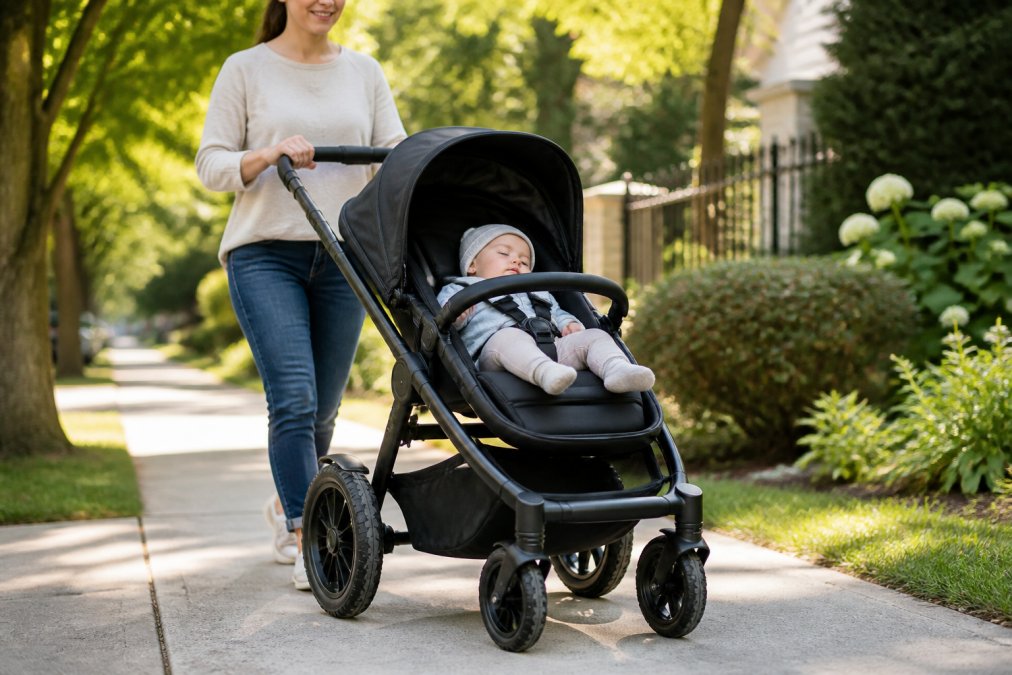
Maneuverability depends on wheelbase and weight distribution. A shorter wheelbase turns tighter in a grocery aisle; a longer one tracks straighter on a long walk but feels heavier in tight spaces. Front swivel wheels with a lock give you both behaviors in one stroller. A stroller with the center of gravity over the rear axle pushes more easily and resists tipping when you hang a diaper bag on the handle.
Ergonomics for the Parent
This is the part most buying guides skip, and it is the difference between a stroller you use daily and one that sits in the garage. Push effort is a function of handle height, grip angle, and where the weight sits relative to your hands. A handlebar that is too low forces you to lean forward and push down; one that is too high makes you reach and lose leverage. An adjustable handlebar lets you set your wrist neutral and elbow slightly bent, the posture that prevents straining on a long walk.
A few concrete checks:
- Handle height range, taller parents generally want a handle that adjusts upward past 40 inches; shorter parents want one that drops low enough to avoid a hunched push.
- Grip shape, a contoured or foam-padded bar spreads pressure across the palm better than a bare metal tube, which matters on longer walks.
- One-hand push, a stroller that tracks straight with one hand lets you hold a coffee, a phone, or a toddler's hand without fighting the frame.
- Step height, a low step-over at the rear axle reduces the chance of kicking the frame with each stride, which is a common complaint on strollers with a high rear bar.
A stroller that forces an awkward grip will shorten your walks, defeating the purpose of buying a comfortable ride for your child. Test handle height and push effort in the store the way you would test a pair of shoes, with your own body, not the spec sheet.
Resale Value: The Financial Case for Premium Strollers
Resale value is the strongest financial argument for buying premium, and the angle most buying guides skip. A stroller that holds its structure and appearance commands a meaningful resale price; one with a cracked canopy and wobbly wheels sells for scrap or not at all.
Three factors drive resale price:
- Brand reputation for durability, which keeps demand steady in the used market
- Availability of replacement parts, which lets a second owner restore rather than discard
- Condition of high-wear components like wheels, canopy, and harness padding
This reframes the purchase. The real cost of a stroller is the purchase price minus what you recover when you sell it. A stroller that costs more upfront but resells at a strong percentage of its original price can cost less to own than a cheaper stroller that resells for almost nothing.
Environmental impact follows the same logic. A stroller that serves two children and then a second family keeps materials in use for years instead of going to landfill after one child outgrows it. Durability and sustainability are the same decision viewed from two angles.
Key Takeaway
Judge a stroller by total cost of ownership, not sticker price. Purchase price minus resale value, plus any replacement parts you buy along the way, is the number that actually matters.
Conclusion
The gap between a budget stroller and a premium one shows up in materials, certification, comfort, and resale, not in the logo. Parents who buy on structure rather than styling keep their stroller longer and recover more of their investment when they sell it.
Modocam Kids curates strollers built around exactly those priorities, with aluminum alloy and carbon steel frames, two-way seating for newborn through toddler stages, and configurations that adapt as your child grows. Browse the collection, compare frame materials and fold types side by side, and choose the stroller that will still be working when your second child arrives.
Frequently Asked Questions
Are premium strollers actually worth the higher price tag?
They can be, if you plan to use the stroller daily for several years. Premium strollers typically use bolder aluminum alloy frames, higher-grade textiles, and sealed wheel bearings that hold up longer than budget models. They also tend to hold resale value better, which offsets part of the upfront cost. If you only need occasional use, a mid-range option may be enough.
Do premium strollers offer better safety standards than budget options?
All strollers sold in the U.S. must meet the CPSC federal safety standard, so the baseline is the same. The difference is usually in how thoroughly a premium brand tests above that minimum: repeated fold-cycle testing, stricter weight capacity margins, and independent lab verification. Ask the brand for its test documentation before assuming a higher price means a higher safety bar.
How does stroller durability impact long-term value for growing families?
A stroller that survives two or three children without failing saves you from buying replacements. Look for chassis durability signals like welded aluminum joints, replaceable wheels, and textiles that resist fading. Modocam Kids' Two-way Newborn Baby Stroller, for example, uses bold aluminum alloy and rubber wheels rated for ages 0 to 36 months, covering the full span most families need.
What features distinguish a luxury stroller from a standard model?
Four things show up most often: a suspension system that absorbs bumps, a one-hand fold mechanism, modular design with parent-facing and world-facing modes, and an infant car seat adapter for travel system compatibility. Fabric quality and an adjustable footrest also separate premium from basic. None of these features alone justifies the price, but together they change daily usability.
