

Cart
0

Last Updated: October 27, 2026
Quick Summary
Reversible seat strollers let you change the seat direction to match your child's needs, so babies can face you for bonding and monitoring early on, then face the world as they grow curious. Because most seats reverse without tools, you can switch mid-walk and flip back whenever your child needs reassurance.
- Parent-facing seats let you catch early hunger, discomfort, and distress cues before a full cry.
- Alternate directions within one outing: parent-facing for calm stretches, world-facing for parks and busy streets.
- After every reversal, push the seat down and pull up to confirm it is locked.
- A rearward-mounted seat shifts weight toward the handle, raising tipping risk on curbs and ramps.
- Most manufacturers advise against reversing the seat while a child is in it.
Table of Contents
- Why Reversible Seat Strollers Give Parents More Options
- Parent-Facing Stroller Benefits: Bonding, Eye Contact, and Monitoring
- World-Facing Seats: How Babies Observe and Explore
- Reversible Seat Stroller Age: Choosing a Direction by Stage
- When to Switch Baby to a Forward-Facing Stroller
- Reversible Stroller vs Fixed Seat Stroller: What You Give Up and Gain
-
Safety Checks and Seat Reversal: Stability, Harness, and Handling
- Confirm the seat is locked in both directions
- Tipping risk and stroller stability on uneven sidewalks
- Five-point harness and seat adjustment checks after repositioning
- Weight limits and recline settings
- Reversing with a child in the seat
- Compatibility with bassinets and infant carriers
- Folding and carrying after reversal
- Choosing a Reversible Stroller at Modocam Kids
- Frequently Asked Questions
Why Reversible Seat Strollers Give Parents More Options
A stroller seat that can face you or face the world is the single most useful feature you can pay for in the first year. The benefits of reversible seat strollers come down to one idea: the seat direction changes with your child's needs instead of locking you into a decision you made before your baby was born.
Here is what we cover: why facing you matters early, when facing out becomes the better call, how to time the switch, and the safety checks that change when you reverse a seat.
Parent-Facing Stroller Benefits: Bonding, Eye Contact, and Monitoring
The parent-facing stroller benefits are practical, not sentimental. When your baby rides facing you, you can see their face without stopping, leaning over, or craning around a canopy.
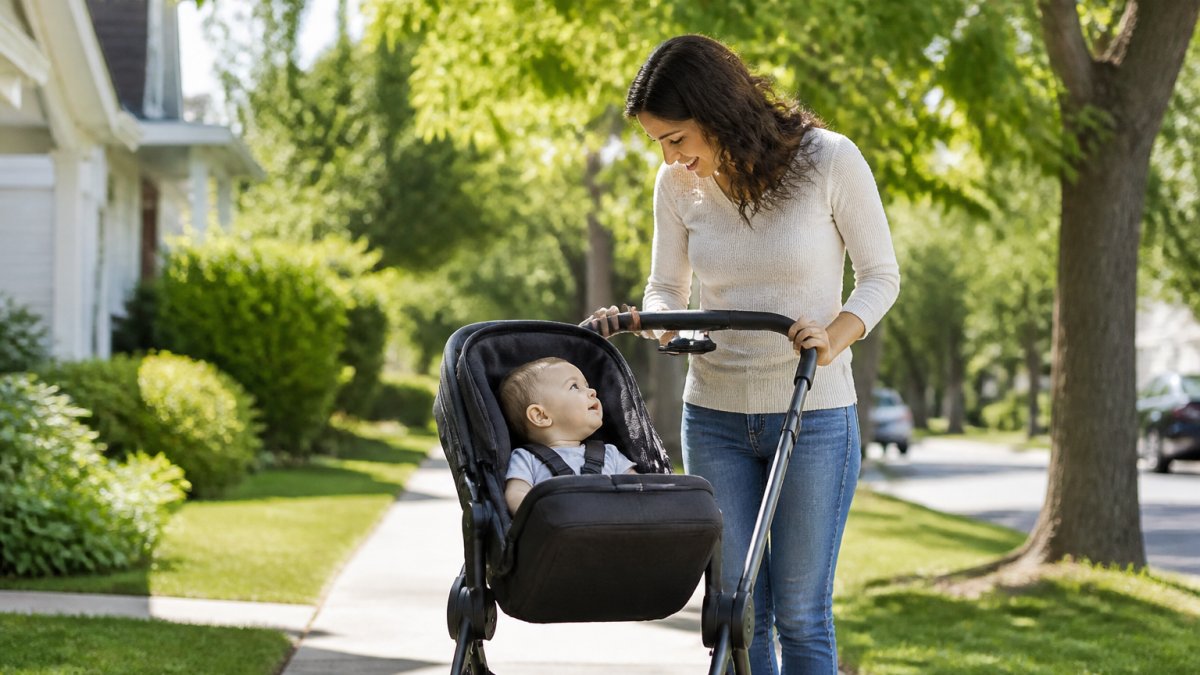
Visual contact and parent-child bonding on the go
Eye contact is how infants read safety. A baby who can see your face gets a steady stream of reassurance during a walk, and you get the same back. Many parents find that errands and walks become a running conversation rather than a transport task, simply because the baby is in view.
Reading visual cues for hunger, discomfort, and distress
This is the benefit nobody puts on the box. Facing you, you catch the early cues: the rooting motion, the squirm that means a wet diaper, the furrowed brow before a full cry. Facing away, you catch them late, usually when the walk is already over. Monitoring a baby's comfort is far easier when the baby is monitoring you right back.
World-Facing Seats: How Babies Observe and Explore
Babies observe and explore by watching. A world-facing seat gives them a wide, changing environment to track, and many parents notice longer, calmer walks once their child can see where they are going. The trade-off is real, though. You lose the easy visual check-in, so a compact mirror clipped to the frame or a quick stop to peek around the canopy helps you stay connected.
Reversible Seat Stroller Age: Choosing a Direction by Stage
There is no single correct age, but there is a reliable sequence. Use the reversible seat stroller age guidance below as a starting point, then follow your own child's cues. The most useful framing is developmental rather than calendar-based: match the seat direction to what your child can physically do and what they seem to need from the walk.
Newborn and infant months: parent-facing first
If either answer is no, parent-facing is the lower-effort choice for both of you.
Older infant and toddler months: world-facing with check-ins
A useful middle path is to alternate within the same outing: start parent-facing for the calm first stretch, flip to world-facing when you reach a park or a busy street, and flip back before a nap or a crowded store. Because the seat reverses without tools on most designs, the switch costs you seconds, not a reinstallation.
Signs your child is ready for more world-facing time
Rather than watching the calendar, watch for these behaviors:
- Reaching toward people, animals, or vehicles passing by
- Turning the head to track movement instead of looking back at you
- Staying calm and upright in the seat for longer stretches
- Showing frustration when the view is blocked by your body or the canopy
Signs to flip back to parent-facing
- Twisting around repeatedly to find you
- Fussing that stops when the seat faces you
- Slumping or leaning to one side in the seat
- Overstimulation in loud, crowded, or visually busy environments
What this guidance is not
This is general consumer guidance drawn from common stroller use, not a developmental assessment. Pediatric professionals differ on exact timing, and some recommend longer parent-facing periods for children with reflux, low muscle tone, or sensory sensitivities. Treat the sequence above as a default to discuss with your child's clinician, not a rule to follow on your own.
When to Switch Baby to a Forward-Facing Stroller
Try a short forward-facing walk first. If your child seems unsettled, flip the seat back. There is no penalty for changing your mind mid-walk, which is the entire point of a reversible design.
Reversible Stroller vs Fixed Seat Stroller: What You Give Up and Gain
For a deeper look at long-term ownership, read our guide on how to choose a stroller for long term use.
Baby Strollers Are Light And Easy To Fold →
Safety Checks and Seat Reversal: Stability, Harness, and Handling
Reversing a seat changes the stroller's balance, so the checks below are not optional. Run them every time you flip the seat, not just the first time. A reversible seat is a convenience feature, not a safety guarantee, the stroller is only as safe as the lock, harness, and weight limits you verify before each walk.
Watch Out
Follow the manufacturer's instructions for your specific model. Seat-reversal procedures, locking mechanisms, and weight limits vary by design, and the manual is the authority for your stroller.
Confirm the seat is locked in both directions
After any reversal, push the seat unit down and pull up gently to confirm it has engaged. Most designs give an audible click and a visible indicator, a colored tab, a window, or a pin that lines up with a mark on the frame. If your stroller has an indicator, check it every time; if it does not, do the push-pull test. A seat that rocks or lifts at the mounting point is not locked.
Tipping risk and stroller stability on uneven sidewalks
A seat mounted rearward shifts weight toward the handle, which raises tipping risk on curbs, ramps, and uneven sidewalks. Push down on the handle with the seat empty to feel where the tipping point sits. Never hang a heavy bag from the handlebar. When you reverse the seat, re-check the balance point, a configuration that felt stable in one orientation can feel tippy in the other.
Five-point harness and seat adjustment checks after repositioning
After any seat reversal, re-check the five-point harness. The straps should sit snug against the shoulders and hips with no slack, and the buckles should close fully. Reposition the canopy and recline to match the new orientation before you set off. A seat that was reclined for a newborn in parent-facing mode may need a different recline angle once flipped, and the canopy may need to be re-angled so it does not block your view or the child's.
Weight limits and recline settings
Check the stroller's weight limit for the seat in each orientation, some models rate the seat differently depending on direction. Confirm the recline setting is appropriate for your child's age and that the seat back is fully engaged, not caught between positions. A partially latched recline is a common cause of a seat that shifts mid-walk.
Reversing with a child in the seat
Most manufacturers advise against reversing the seat while a child is in it. Even on designs that allow it, the safer habit is to remove the child, reverse the seat, confirm the lock, and then re-seat and re-harness. If your model permits in-seat reversal, follow the manual's sequence exactly.
Compatibility with bassinets and infant carriers
If you use a bassinet or an infant car seat carrier with the stroller, confirm that the accessory locks in the orientation you intend and that reversing the seat does not interfere with the accessory mount. Some frames require the seat to be removed before a bassinet or carrier can be attached, and some do not allow the seat and carrier to be used in every combination.
Folding and carrying after reversal
If folding and carrying matter to you, our lightweight stroller that folds easily is worth a look.

Choosing a Reversible Stroller at Modocam Kids
We stock reversible options. For a curated list, see the best baby strollers for modern parents. The portable children's stroller handles 15 kg.
Two more worth comparing: our lightweight foldable stroller with a reversible function and four-wheel shock absorption, and the two-way stroller with a retractable push handle built on a reinforced high-carbon steel frame.
| Stroller | Price | Seat Function | Best For |
|---|---|---|---|
| Light and Easy to Fold | $52.57 | Reversible, four-wheel shock absorption | Daily walks on mixed pavement |
| Two Way Lightweight Foldable | $48.80 | Reversible, retractable handle | Parents who share pushing duties |
| Two-way Sit and Lie | $43.05 | Two-way push, sit and lie flat | Newborns through toddlers |
| Sit, Lie, and Fold | $39.15 | Reversible, shock absorbing | Budget-conscious first-time parents |
Frequently Asked Questions
What is a reversible seat stroller?
Modocam Kids carries the [Two Way Stroller Lightweight Foldable Stroller](https://modocamkids.com/products/two-way-stroller-lightweight-foldable-stroller) at $48.80 and the [Two-way Baby Stroller, Sit And Lie, Foldable Lightweight Stroller](https://modocamkids.com/products/two-way-baby-stroller-sit-and-lie-foldable-lightweight-stroller) at $43.05. The first is listed with a reversible function; the second is listed as a two-way push stroller.
What are the main parent-facing stroller benefits?
Parent-facing stroller benefits center on connection and monitoring. Your baby can see your face, which supports parent-child bonding and visual contact during walks. You can also read visual cues for hunger, discomfort, or distress without stopping to peek around the canopy. For newborns and young infants, that close supervision is a practical advantage, especially on longer outings or in busy places.
When should a baby face forward in a stroller?
There is no single rule, but many parents switch to world-facing around 6 to 12 months, once the baby can sit well with head and neck control and shows interest in surroundings. Watch for cues like turning toward noise or reaching to see past the canopy. Keep the five-point harness snug and check the seat is locked in position after every reversal. Some children still prefer parent-facing on busy days.
Are reversible seat strollers worth the extra cost?
Modocam Kids offers the [Baby Strollers Can Sit Or Lie Down And Fold Lightly To Absorb Shock](https://modocamkids.com/products/baby-strollers-can-sit-or-lie-down-and-fold-lightly-to-absorb-shock) for $39.15 and the [Baby Strollers Are Light And Easy To Fold](https://modocamkids.com/products/baby-strollers-are-light-and-easy-to-fold) for $52.57.
The hardest part of buying a stroller is committing before you know your child's personality. A reversible seat removes that gamble. Modocam Kids stocks reversible strollers with sit-and-lie positioning, four-wheel shock absorption, and foldable frames built for daily use. Get started with Modocam Kids and pick a stroller that adapts as your baby grows.

