

Cart
0
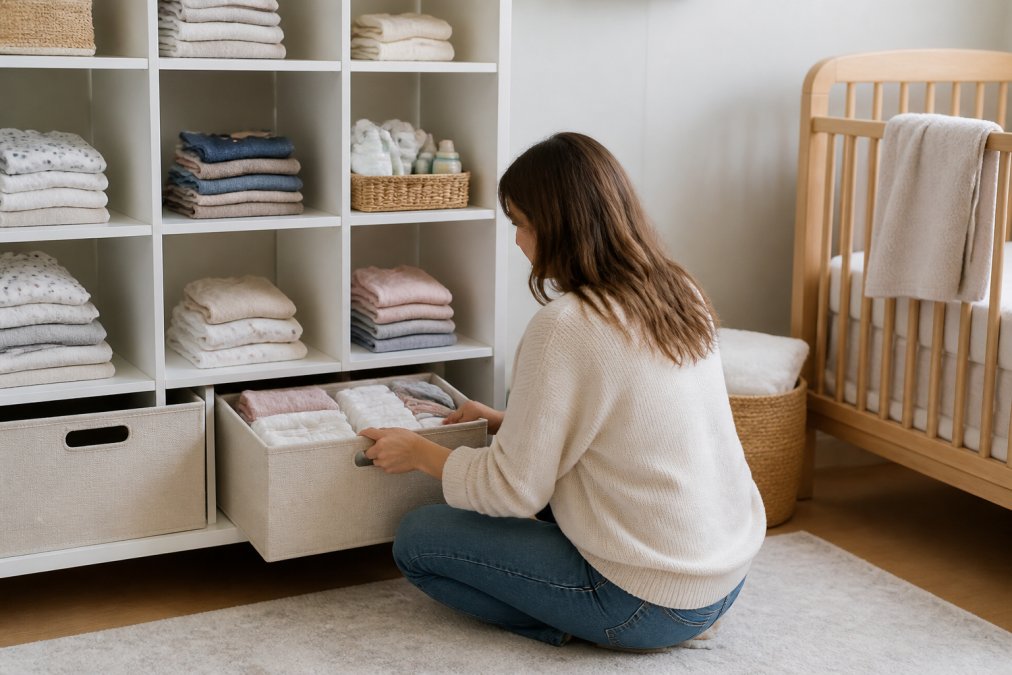
Table of Contents
- What You'll Need Before You Start Organizing
- Nursery Storage Zones: Categorizing Baby Items by Type
- Nursery Dresser Organization Tips That Actually Work
- How to Organize Baby Clothes Without the Clutter
- Small Nursery Storage Solutions That Scale With Your Baby
- Safety-First Anchoring and Long-Term Nursery Storage Planning
- Building a Simple Inventory System for Baby Essentials
- Conclusion
Last Updated: August 24, 2026
What You'll Need Before You Start Organizing
The biggest mistake most parents make is shopping first and planning second. You end up with baskets that don't fit your shelves and a closet rod installed at the wrong height.
Here's what to gather before you start:
- Measure your nursery dimensions, including closet depth, shelf heights, and space beside and beneath the crib
- Take inventory of everything you already own, including baby shower gifts and hand-me-downs
- Identify your primary storage furniture: dresser, changing table, closet, and any open shelving
- Decide on a color palette or material style so storage containers look cohesive
- Set a realistic budget before browsing storage products
Nursery storage is not a one-time setup. A system that works at three months will be wrong at twelve months. Plan for growth from the start.
According to the American Academy of Pediatrics safe sleep guidelines, the sleep environment and surrounding furniture arrangement directly affect infant safety, which means your storage layout is a safety decision.
Pro Tip
Before installing any shelving, download your nursery floor plan dimensions and sketch three storage zones: one for diapering, one for clothing, and one for gear. This prevents duplicate purchases and reveals gaps before you spend anything.
Nursery Storage Zones: Categorizing Baby Items by Type
Effective nursery organization is built on zones, not just containers. A zone is a dedicated area where every item in that category lives. When everything has a fixed home, restocking at 3 a.m. becomes automatic rather than a fumbling search in the dark.
The zone approach also makes it easier to hand off care to a partner, grandparent, or babysitter without needing a tour.
Diapering and Feeding Essentials
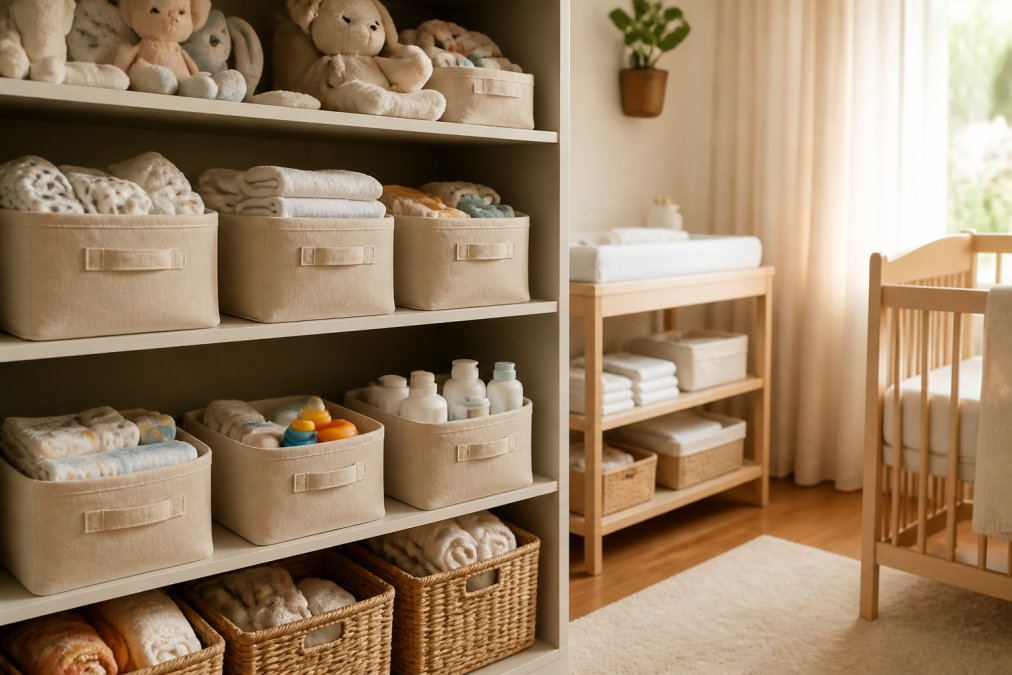
The diapering zone should be built around your changing table. Everything you need for a diaper change must be within arm's reach while one hand stays on the baby. A diaper caddy on the changing table surface is the most efficient solution: stock it with diapers, wipes, rash cream, and a spare onesie. Refill from a dedicated storage bin underneath or in the closet.
For feeding essentials, keep bottles, formula, burp cloths, and a bottle brush in one drawer or cabinet shelf near the feeding chair. Breast pump parts belong in a labeled canvas basket or zippered pouch inside a storage bin.
Baby Gear and Daily-Use Items
Baby gear defeats most nursery organization systems. Swings, bouncers, play mats, and carriers are large and awkward. Large gear belongs outside the nursery when not in active use.
For daily-use items inside the nursery, think in terms of frequency. Items used every day, like the baby monitor and pacifiers, should be at arm's reach. Items used weekly go in a drawer. Items used monthly or less go in a labeled storage container on a high shelf or in the closet.
Nursery Dresser Organization Tips That Actually Work
The dresser is the workhorse of nursery storage. A typical six-drawer dresser can hold every piece of clothing a newborn owns plus blankets, swaddles, and accessories if organized properly.
The most common mistake: folding clothes flat and stacking them. You can only see the top item. Use the file-fold method instead, standing each item upright so you can see every piece at a glance.
Using Drawer Dividers to Maximize Every Inch
Drawer dividers are the single most impactful nursery organization tool you can buy. Without them, baby items migrate and mix. With them, every category stays put.
Here's a practical drawer assignment system for a standard dresser:
| Drawer | Category | Notes |
|---|---|---|
| Top drawer | Diapering extras | Backup wipes, creams, thermometer |
| Second drawer | Onesies and bodysuits | File-folded by size |
| Third drawer | Pants and leggings | File-folded, separated by season |
| Fourth drawer | Sleepwear and swaddles | Rolled for easy grab |
| Fifth drawer | Accessories | Hats, socks, mittens in divider cells |
| Bottom drawer | Blankets and extras | Seasonal items or next-size clothing |
Adjustable drawer dividers work better than fixed ones because categories shift as your baby grows.
Watch Out
Avoid overloading dresser drawers to the point where they're difficult to open with one hand. You will always be operating with one hand in the nursery. A drawer that requires two hands to open is a safety and usability problem.
How to Organize Baby Clothes Without the Clutter
Baby clothing clutter accumulates faster, becomes obsolete faster, and arrives in unpredictable quantities from well-meaning relatives. The solution is a system, not a bigger closet.
Sorting by Size and Managing Outgrown Clothing
Sort all clothing by size before it enters the closet or dresser. Keep only the current size and one size up in the dresser and accessible closet. Store the next two sizes in a labeled storage bin on a high closet shelf. As items are outgrown, immediately move them to a "donate or keep" bin and process it monthly.
The Consumer Product Safety Commission guidelines on children's sleepwear recommend checking clothing labels for flame resistance requirements as babies grow into larger sizes.
Key Takeaway
Managing outgrown clothing is an ongoing process, not a one-time event. Set a monthly reminder to audit the dresser and closet. It takes ten minutes and prevents drawer overflow.
Closet Organization: Closet Rod and Vertical Storage Strategies
Most nursery closets come with a single closet rod at adult height. A double closet rod setup, with one rod at roughly 40 inches and a second at 20 inches, effectively doubles your hanging capacity for baby clothes.
Vertical storage is the most underused dimension in nursery organization. Consider:
- Over-the-door organizers for small items like shoes and accessories
- Stackable storage bins on the closet floor for seasonal items
- Shelf dividers to keep folded stacks from toppling
- Clear storage containers on upper shelves so you can see contents
- Labeled canvas baskets for categories that don't need to be visible daily
Use the full height of the closet while keeping the most-used items between knee and shoulder height.
Small Nursery Storage Solutions That Scale With Your Baby
Small nursery storage solutions adapt as your baby's needs change dramatically over the first two years.
Rolling Carts, Canvas Baskets, and Modular Storage
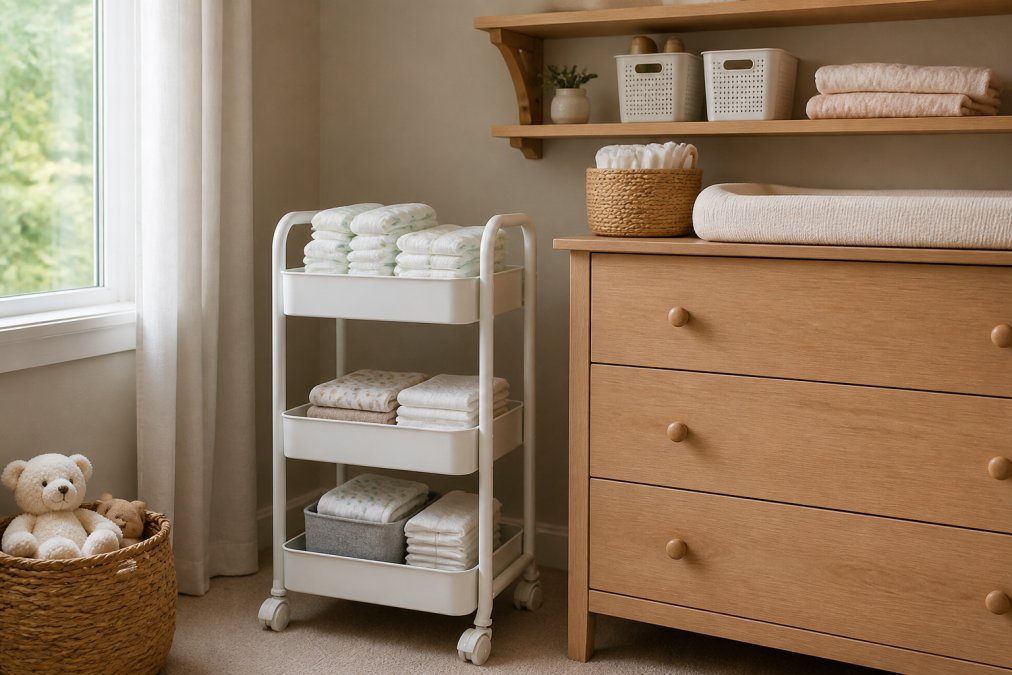
A rolling cart beside the changing table is one of the most practical investments in a small nursery. It holds diapers and changing supplies at the newborn stage, transitions to bath supplies at six months, and becomes a toy station at twelve months.
Canvas baskets and fabric bins are the most versatile nursery storage containers. They're soft-sided and won't injure a curious baby, and they compress when empty. Use them on open shelves for items that need to be grabbed quickly: burp cloths, swaddles, and small blankets.
Modular storage systems that can be reconfigured are worth the investment for families who plan to use the room beyond the nursery stage.
Repurposing Furniture and Budget-Friendly DIY Hacks
The best nursery storage hack is also the most budget-friendly: use what you already own. A bookshelf from another room becomes an open nursery storage unit. A small side table becomes a diaper caddy stand. A hanging shoe organizer becomes a pocket system for small essentials.
Practical DIY approaches include tension rods inside cabinets to create extra shelf layers, pegboards on walls to hold baskets and hooks, and repurposed spice racks to hold small bottles and accessories.
Safety-First Anchoring and Long-Term Nursery Storage Planning
Any freestanding furniture in the nursery, including dressers, bookshelves, and modular storage units, must be anchored to the wall. Tip-over accidents involving furniture are a leading cause of injury for children under five. Anti-tip straps are inexpensive and install in minutes.
Long-term planning means designing your nursery storage system to last beyond the first year. Will this shelf work when your child is two? Will this dresser still be useful at five? Furniture that grows with your child is a better investment than nursery-specific pieces.
Key principles:
- Anchor every freestanding piece of furniture over 30 inches tall to a wall stud
- Avoid placing heavy storage above the crib or changing table
- Choose storage containers with lids or closures as your child becomes mobile
- Reassess the entire system at six months, twelve months, and twenty-four months
- Keep a small emergency kit in a high, locked location once your baby becomes mobile
According to the CPSC furniture tip-over prevention resources, anti-tip devices are one of the most effective preventive measures families can take in rooms where young children spend time.
Building a Simple Inventory System for Baby Essentials
An inventory system sounds complicated but isn't. The core idea: know what you have, know where it is, and know when to restock before you run out at midnight.
A simple nursery inventory approach:
- Create a master list of consumable items: diapers by size, wipes, formula, rash cream
- Set a restock threshold for each item, for diapers, many parents use one week's supply as the trigger
- Designate a "running low" spot, a small basket near the nursery door, where you place nearly-empty items as a visual reminder
- Review the list weekly, not when you've just run out
For clothing, a simple size-based inventory prevents both overstocking and gaps. Keep a note in your phone of what sizes you have in each category.
Clear, consistent labels on every storage bin, basket, and drawer make the system usable by anyone caring for your baby. The format doesn't matter; the consistency does.
As your baby grows, the inventory shifts. Newborn diapers become size 3. Swaddles become sleep sacks. The system itself stays the same; only the contents change.
For parents looking to source quality storage essentials alongside baby clothing and feeding products, Modocam Kids offers a curated selection of baby and children's essentials designed with both function and comfort in mind.
According to the American Academy of Pediatrics guidance on safe home environments for infants, organized, accessible storage directly supports safer caregiving routines, particularly for nighttime feedings and diaper changes where speed and simplicity reduce risk.
Nursery storage is one of those things that feels manageable until it isn't. The parents who struggle most are the ones who set up a system for a newborn and never revisit it. Modocam Kids is built for parents who want products that grow with their child, from newborn essentials through the toddler years, without starting over at every stage. Explore our full range of baby essentials and find the storage and organizational products that fit your nursery layout. Add to Cart the pieces that work for your space and let the system do the rest.
Frequently Asked Questions
Q: How do I maximize storage in a small nursery?
A: Focus on vertical space first: wall-mounted shelves, a double closet rod, and over-door organizers free up floor area fast. Choose furniture that multitasks, such as a dresser that doubles as a changing table. Rolling carts tuck under shelves when not in use, and modular storage bins stack as your needs grow. Labeling every bin keeps the system working even when you're sleep-deprived and grabbing things in the dark.
Q: How should I organize baby clothes by size?
A: Sort clothes by size range before they go into the dresser or closet. Keep the current size at the front and store the next two sizes in clearly labeled bins or vacuum bags on a high shelf. When an outfit is outgrown, move it immediately to a dedicated 'outgrown' bin. This prevents clutter from building up and makes hand-me-down sorting straightforward. Drawer dividers help keep each size group separated inside the dresser.
Q: Where should I store diapers for easy access?
A: Keep a diaper caddy or small rolling cart directly at the changing station with a one-to-two day supply of diapers, wipes, and cream. Store the bulk supply in a lower dresser drawer or a labeled canvas basket on a nearby shelf. This two-tier system means you never run out mid-change, and restocking takes seconds. Avoid storing diapers under the crib where they become hard to reach and tend to accumulate clutter.
Q: What are the essential storage items for a newborn nursery?
A: A diaper caddy for the changing station, drawer dividers for the dresser, labeled canvas or fabric bins for the closet, and a rolling cart for frequently used baby gear cover most newborn needs. Add a small hamper near the changing table and a dedicated basket for the next clothing size up. These basics keep baby essentials accessible without overcrowding the nursery layout, and most can be repurposed as your child grows.
This article was written using GrandRanker

